South Frontenac Community Services AGM and Community Paramedicine
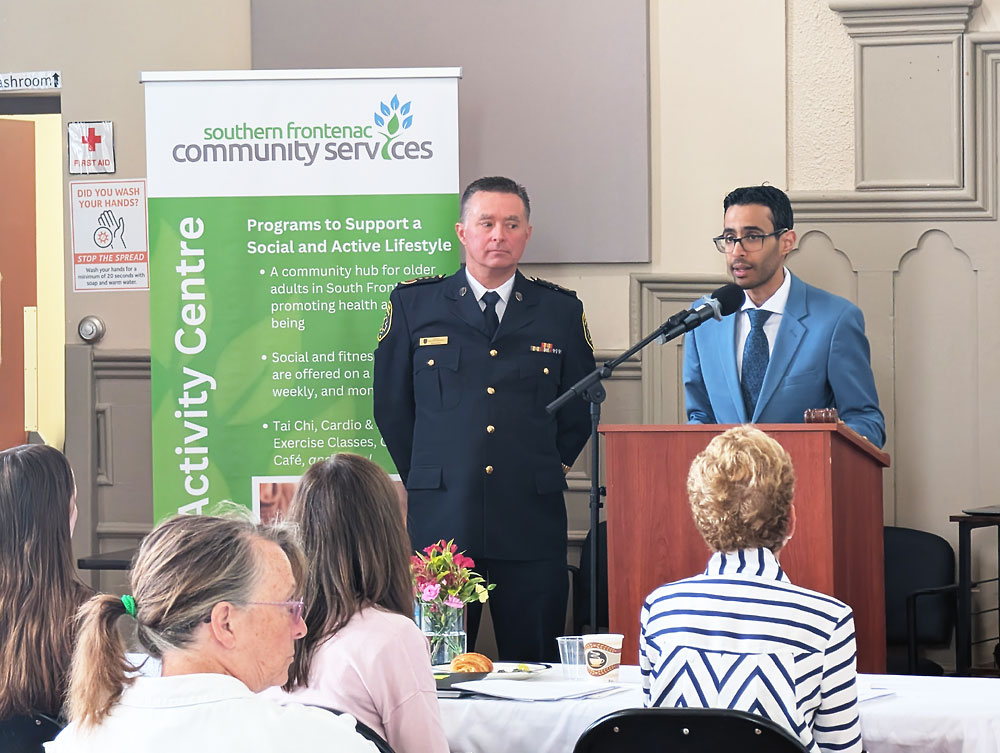
Michael van Hartingsveldt has been a paramedic for 35 years, and his current role is that of Supervisor of Performance Standards with Frontenac Paramedics. He oversees the 8-member community paramedicine team under the Frontenac Paramedic Services umbrella.
Dr. Aws Amulfleh was two years old when Michael Van Hartingsveldt started his career as a paramedic. He is now a cardiologist at Kingston Health Sciences Centre (KHSC), and his clinical specialty is heart failure. He is a passionate advocate for educating the public about heart failure and ways in which it can be treated in the community.
The two of them began meeting in 2024 when Dr. Amulfleh approached Van Hartingsveldt about doing some training so that the Frontenac Community Paramedicine team could work with the team of physicians and nurse practitioners, at the Heart Failure Clinic that Dr. Amulfleh oversees at KHSC.
They set up a pilot project for the clinic and the community paramedics to work together, with the goal of improving the outcomes for patients, by providing more care at home, and reducing emergency department visits and hospital admissions.
They gave a tag team presentation to a full house who had gathered at the Grace Centre, for the Annual General Meeting of Southern Frontenac Community Services.
Michael Van Hartingsveldt outlined how busy Frontenac Paramedic Services has been since 2021. He said that a lot of the focus for the service has been the “unattached” population in the City of Kingston, referring to people, mainly seniors, who are not “attached” to a primary care clinic. The community paramedicine program is also active in Frontenac County, and has a partnership with North Frontenac Township.
He said that in 2025, the 8 member team conducted over 5300 in-person visits at patients’ homes and paramedicine clinics, and 13,620 total contacts with patients. The team has access to a nurse practitioner for three hours each day, operating as a complementary service to the emergency service, offered by Frontenac Paramedic Services under contract with the Ministry of Health.
Dr. Amulfleh said that he contacted Van Hartingsveldt in 2024 because of what he has learned since starting his practice at KHSC treating patients with heart failure.
He said that during his medical training he learned almost nothing about care outside of the hospital setting, but since arriving at KHSC he has learned a lot about the limitations of hospital care for people with heart failure, which he described as very much “a treatable condition”.
He said that the average patient who presents with heart failure at the hospital emergency department, by going themselves or by ambulance, spends 5 -10 days in hospital as an admitted patient. But before that they spend up to 24 hours in the emergency department, and once admitted they spend another 2-3 days in a bed in the emergency department waiting for a room to open, and then they spend another 5-10 days in hospital. The cost is about $13,000 dollars to the healthcare system .
“And the outcome after leaving hospital is not great either,” he said, “20% of patients are re-admitted within 30 days, and a third of those end up back in the emergency department again before being re-admitted.”
When the pilot program started, the community paramedics received special training to help them identify heart failure symptoms and provide treatment. One of the first things that was put in place between the KHSC Heart Failure Clinic and the Frontenac Community Paramedics, was to have community paramedics visit heart failure patients within 24 hours of their discharge from hospital to provide continuity of care.
In the home setting, Van Hartingsfeldt said, community paramedics can do more than just testing. They are able to sit for longer with patients in a more comfortable environment than a clinic or emergency room, and they can see what physical barriers people face in the home that need to be addressed.
“We also get a picture of patient circumstances. Food insecurity, for example, is very common,” he said.
Through video conferencing, community paramedics can even facilitate doctor or nurse practitioner examinations, all from the home.
Dr. Amulfeh said that the program has success in terms of patient care and has also savings in hospital costs, which are the highest cost and often least desirable healthcare setting.
He thinks the program could be extended beyond heart failure, to other conditions that are common in the senior population, and where the rates are higher in Frontenac County than in urban centres, such as Chronic Obstructive Pulmonary Disorder (COPD) and Diabetes.
The presentation ended and a lively question period followed.
The meeting began with a breakfast, expertly prepared by Elisa Corrigan of Rampant Kitchen, followed by the introduction of the Southern Frontenac Community Services Staff, and a short business meeting. South Frontenac Mayor Ron Vandewal and Chief Administrative Officer Louise Fragnito brought greetings from the township and talked about how SFCSC is an integral part of the local community, which has an elevated aging population as compared to urban centres.
SFCSC Executive Director Heather Rogers said that the agency is working hard to address the issues faced by seniors in the local community, and that in addition to the programs offered at the Grace Centre, many of the agency’s programs targeting the frail senior population, such as its Adult Day Program, are at capacity, and the need for service is about to increase in a major way.