Blue Skies Festival Organisers Gather To Mark The Passing Of Oskar Graf
It was nothing like the thousands who gather on the August long weekend each summer at a normally abandoned field, halfway up the Clarendon Road, off Road 509 north of Sharbot Lake, but a few hundred people arrived gradually last Friday for a one time event.
They set up their tents in different pockets of more or less level ground around the property and met for a potluck, just as a few dozen do each year when the September meeting, one of 6 meetings throughout the year, usually takes place.
But instead of a meeting, the Saturday afternoon crowd, swelled from people arriving just for the afternoon, gathered in the natural amphitheatre around the stage that is the centre of the annual festival, as the long time festival MC Magoo (aka Bruce McGregor) introduced the current general co-ordinator of Blue Skies, Jenn Wilson, who outlined how the simple celebration would be carried out. Dave Tilston, a former general coordinator sang a version of a song, with help from Magoo and a few musicians, that he wrote about ten years ago, about how the festival emerged each year, with a couple of verses added about Oskar Graf.
He said that he wrote the new verses a couple of days after learning of Oskar Graf's passing in late August at the age of 81, and it took him a couple of weeks to be able to sing through it.
There were no formal speeches at the memorial, just an opportunity for people to speak briefly about their memories of Oskar Graf.
John Peter, who lived for a time in the original cabin on the property that Oskar bought in 1971 with his first wife Susan, (Shoshana), talked about them being part of a rag tag group of “back to the landers” who had the goal of being subsistence farmers in a harsh landscape.
He talked about one time when Oskar and him decided to live only on what they could kill, which mercifully for them included potatoes and how that led them to kill a porcupine and the spend hours figuring out, without the benefit of a Youtube video, how to skin it and retrieve “a couple of mouthfuls of red meat” without getting quills anywhere in their body.
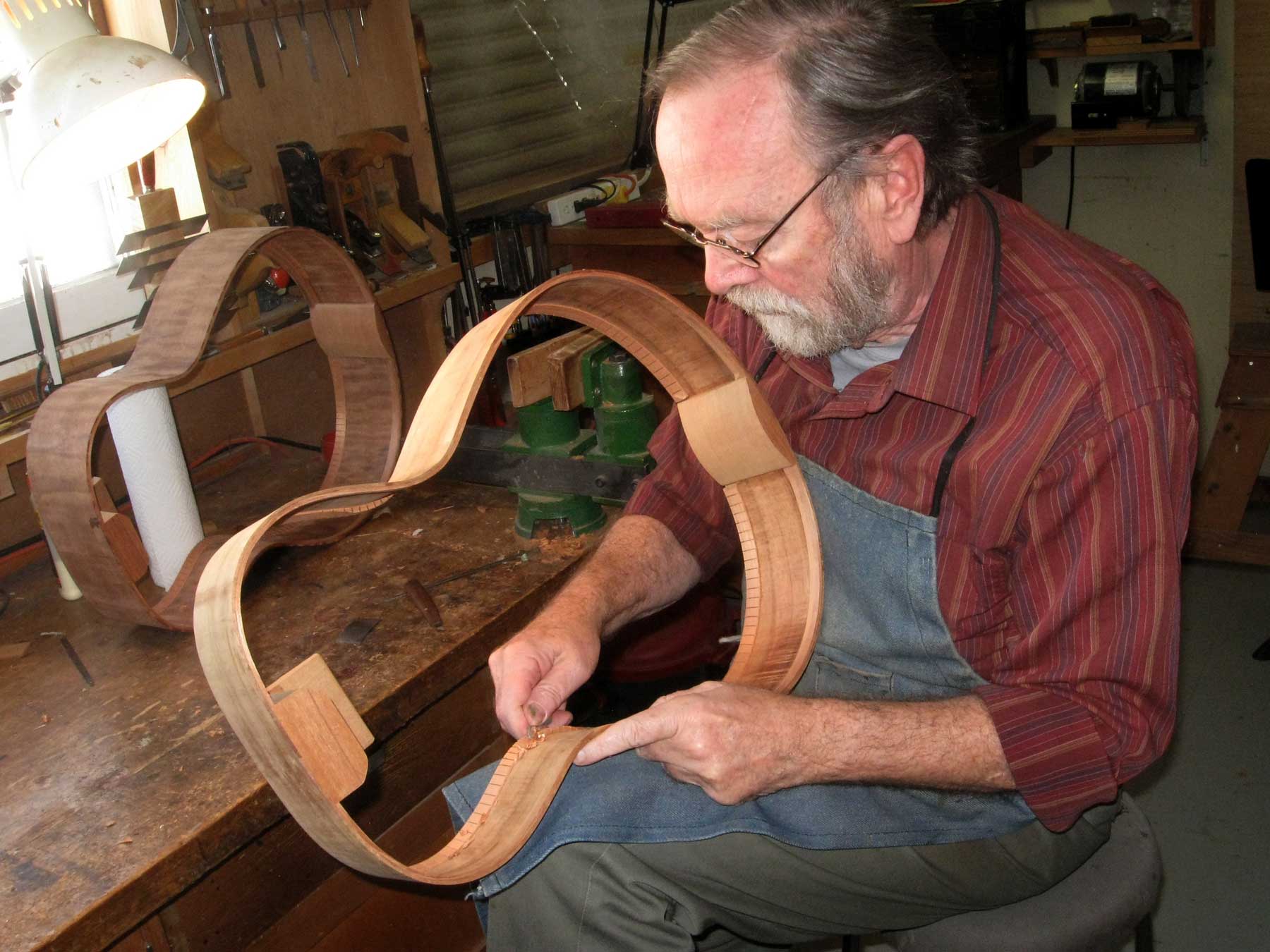
Oskar was a German immigrant to Canada, trained in cabinet-making. He moved to Toronto first, in the 1960s, before being attracted to rural Canada, which led him to buying the 100+ acre property on the Clarendon Road. He not only built a house on the property, but also learned how to make instruments, starting off by making dulcimers and other stringed instruments. He made his first two guitars in 1973, and although he was self taught for the most part, he learned some techniques from John Larivee of Larivee Guitars, who he met through the Toronto Folklore Centre. He made guitars out of his home-based shop for 40 years, mostly 12-string and classical guitars. He retired in 2014, after building over 500 guitars and establishing a reputation in the Canadian and international music community.
By the time he decided to hold the first festival/picnic on the August long weekend, a kind of loose, alternative community had been established in locations around Kingston, Frontenac and particularly in nearby Lanark County. and people came to Oskar and Susan's out of the way property in much larger numbers than anticipated, and the Blue Skies Music Festival came out of that gathering and grew into more or less the same form it takes now, in a few short years.
One of the striking things about the celebration at Blue Skies last weekend, was that while Oskar had not been involved in the workings of the festival, for well over a decade, the basic principles that he established in the first few years, are still at the core of the event itself, and are what makes it unique among cultural events in Canada.
No vendors, no sponsors, no paid staff, and equal pay for all musicians. These were ideas that came from Oskar Graf and were cemented in the development of a consensus-based organisational structure at the festival. This has kept it small, along with the realities of the site where it is based, and out of the mainstream. But it has also proven to be a business model that works as well in 2025, as it did in 1975 and 1995.
He did not look at the principles as idealistic, but as practical. He said once that when he realised that the festival was more than a one time picnic, he resisted the idea of setting up artisan booths, even though many of the people around him, and the festival, were and still are in the craft world, and Blue Skies was drawing people with money from Toronto and Ottawa.
“We wanted it to be a week off for the crafters. It wouldn't have been that way if we had craft booths, and the site is pretty rough and out of the way for a craft show anyway,” he said.
Christine Peringer, who was also a one-time general co-ordinator of the festival and now takes minutes at the meetings, said that she has been involved in a number of not-for-profit organisations over the years, some that were started by one person, and what stands out for her about Oskar Graf and Blue Skies is the extent to which he set up a culture where roles are passed on over and over again, starting with his own, once central role, as the Blue Skies guy.
This happened over time. As recently as 15 years ago, Oskar was still the guy who printed and put up a couple of dozen posters, to post around Sharbot Lake in the week before the festival for people who might want to come out for the day, even though camping passes are sold through a lottery in the spring each year.
One of the key aspects of ensuring the festival's future was the decision to sever off the festival site and sell it to the Blue Skies Cultural Centre, the not-for-profit charitable corporation that was set up in the 1980s to run the festival. That happened in the early 2000s. And in 2015, Oskar sold his house as well, and moved to Westport.
Long removed from the festival organisation, he rarely attended Blue Skies meetings in recent years, and was nowhere to be found at the Zoom meetings that took place during the two years when the physical festival went dark and was replaced by a virtual one. But he did intervene once. In early 2022 when COVID had become a political lightning rod, and controversies over masking rules and vaccines were headed towards a fever pitch, and the convoy had descended on Ottawa, the Blue Skies organising group was also at a point of dysfunction. A decision had to be made whether to hold the festival in August of 2022, or to hold off again.
Martina Field, one of the organisers who was at that meeting, recalls that Oskar was there, and at an important moment in the meeting he spoke.
“He said, ‘when we started this festival, we were risk takers, we were not afraid, we took chances.”
The festival was held in 2022, and the finances of the Blue Skies Cultural Centre, which were decimated over the two year hiatus, having put on two virtual festivals, have since recovered.
Oskar Graf spent his retirement years travelling, visiting with friends in Eastern Ontario and around the country, and with family. He even continued to build a few guitars each year. He is survived by his son Tony, his extended family, and a devoted group of friends. An event will be held in Westport later next month to celebrate his life.