3rd Annual Wild Art Walk at Milburn Creek Conservation Area
In my day job, I’m learning how to teach little kids to love nature. I’m happy to report that it does not take much coaxing. Nature is beautiful and humans are wired to be in awe of it. But we have some exercises we run through because sometimes if children are not exposed to nature often, they need a little guidance on how to interact with it.
We ask them to find a leaf that speaks to them. We ask them to look at it for a minute and tell us all the things they notice. Sometimes they notice the colour, or the holes, or the way that each side of the leaf is a perfect mirror of itself. After all of the noticing, we move on to wondering. They wonder when exactly the leaf fell and why it landed where it did. They wonder what little life made the hole and where the leaf will land when they drop it — or where it would land if they never picked it up.
We ask what the leaf reminds them of. Sometimes the leaf is red and reminds them of a firetruck or a fire or a sunset. Sometimes the leaf reminds them of a spider web or another leaf or their cat.
This weekend, I decided to test my training by taking my almost four-year-old to Milburn Creek Nature Reserve to see the Wild Art Walk in Battersea.
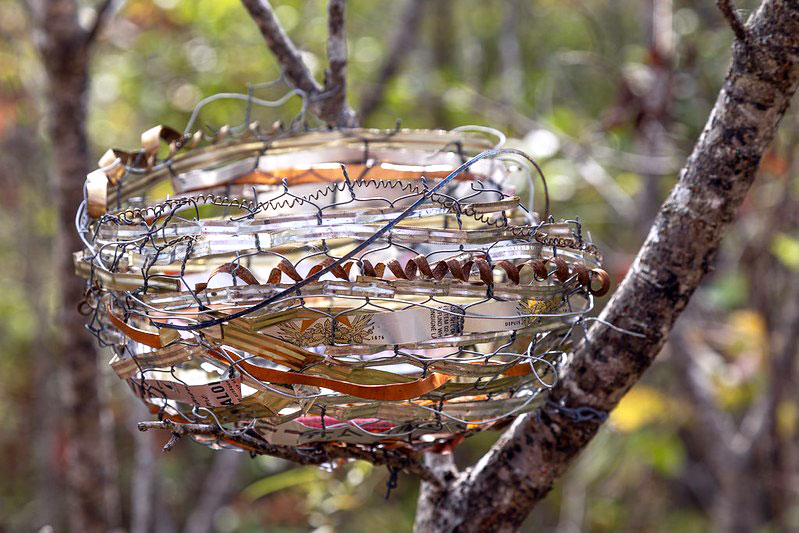
Wild Art Walk is an initiative organized by Sarah Wiseman that, for the last three Octobers, has been bringing a free outdoor art gallery to Milburn Creek Nature Reserve for the public to meander through and reflect on the beauty of nature and the connection and responsibility we hold as humans.
This year, there are approximately 15 installations that bring this reflection and connection to light using a mix of natural and manmade materials from both professional artisans and people who submitted a piece for the first time. According to Wiseman, the key to a successful art walk is to not curate the pieces too much and without a theme, more people come out of the woodwork to display their art.
“It's important to us that the event is not juried and not curated. There is no theme. The community just brings what they want, what they're feeling inspired to bring. It’s about making it accessible for established artists and also for people who have never shown their art before,” she said.
Unfortunately, this year a few of the installations have been vandalized. Wiseman said the organizing committee is still working through how best to address the situation — balancing the desire to protect the pieces with the spirit of openness and accessibility that defines the event. “It’s disappointing, but it also opens up another conversation about respect — for art, for nature, and for shared spaces,” she said.
Despite there not being a theme, there are some pieces that work in congruence with each other and along the trail, each piece popped out like a piece of a puzzle, connecting us deeper to our reflection. According to Wiseman, this serendipity is part of the exciting nature of the installations.
“It’s really exciting to see how pieces work together. We have [installations] with very similar shapes and cores, but they're made of different materials. Without any curation, they just sort of pair together perfectly. It’s really amazing to see.”
As we walked through the trail, with brilliant coloured leaves slowly floating to the ground, a feeling of deep appreciation for this life and the world around us came over my son and me as we walked hand in hand throughout the trail. Each piece brought a new sense of wonderment to him — a feeling that Wiseman wanted to capture with the walk, especially in this intense geopolitical climate.
"I think it's important for people to pay attention to what's around them,” she said. “The walk encourages people who are just walking the trail to think about the land in a different way, and that's always important."
As we reached the end of the trail, my son stopped to pick up one last leaf, a large, golden one that had landed right in the middle of the path. He held it up to the sunlight and said, “It’s shiny, like it’s trying to be the sun.” I couldn’t help but smile, because in that simple observation was something that felt so true about all of it, the art, the walk, the people who made it possible.
In so many ways, humans have always tried to capture what nature already does effortlessly. Through art, we mimic the patterns, the symmetry, the movement, the beauty that surrounds us not because we think we can improve it, but because we want to feel closer to it. The Wild Art Walk is a reminder of that impulse: that deep, timeless longing to connect, to create, and to belong to something larger than ourselves.
You can visit the Wild Art Walk for the rest of the month of October.