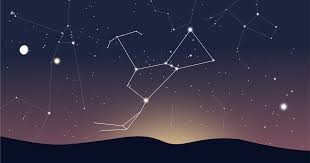
The Night Sky For November
Comet Atlas is near Venus, Comet Swan has moved across the southern sky and now in the SE, and Comet Lemmon is approaching Ophiuchus. The Orionid Meteor shower is still happening and there are three more Meteor showers in November. Lots to try to see. Winter constellations are rising early in the morning sky.
Mercury will be very low in the ENE in the evening sky. It will become easier to find as the month moves on. Venus, on the other hand, will be visible in morning twilight low in the ESE. Mars will not be visible again this month. Jupiter will be rising after 9 PM in the ENE. It will transit (cross the imaginary centre line of the sky) before 5 AM and be high in the S by dawn. Saturn’s rings are appearing to tilt as seen from Earth. This makes them look very thin, like a line not a handle.
During the week of November 2, the tides will be large due to the Supermoon’s gravitational tug. Saturn and the Moon will appear near each other and if you have a telescope, you might add Neptune to that group. If you are observing the Moon with binoculars or telescope, you might be able to see Wargentin Pancake on the limb on the Moon. The name does describe it. The Full Moon, (Animal Fattening), will be on the 5th and the closest approach of the year. This is now called a Supermoon (356832 km). Even I would be hard pressed to tell the difference in size or gravity but oceans certainly can. On the 6th, the Moon will be just N or the Pleiades (an Open Star Cluster forming the shoulder of Taurus, the Bull). This grouping is often mistaken for the ‘little dipper’ because it is a similar shape and much smaller than the other two ‘dippers’. You should notice some fuzziness around these stars as there is some of the star forming material being lit by the stars that have already formed. This group can be used to judge how dark your skies are by how many of the stars can you see. These are an Open Cluster because they were born of the same nebula and are now moving apart. As this group reminds people of the dippers it inspires a story. The Pleiades is also called ‘the Seven Sisters’ (and for those who are counting, there are seven stars in the Big Dipper). Now the story goes that the Seven Sisters were married to the Seven brothers in the big Dipper. All but one couple were unhappy and did not want to remain married. So the Gods separated them forever making the two Asterisms. What happened to the two who wished to remain together, you ask? Mizar and Alcor remain as a visible double star, second from the end of the handle of the Big Dipper. Seeing this pair as a pair was an ancient eye test. When they were seen with telescopes, they turn out to be Double Doubles. A visible double means that they appear together from Earth but are really very far apart. But each of those stars has another orbiting with it.
On November 9, Mercury will appear stationary and on the 10th Jupiter will be just South of the Moon and will appear stationary on the 11th. The North Taurid meteor shower peaks in the predawn of the 12th. Zodiacal light may be visible in the morning sky from the 14th to 28th from a dark sky. On the 17th the Leonid meteor shower peaks in the predawn. On the 19th, the Moon will be at Apogee (furthest from Earth 406692 km). New Moon is on the 20th and Uranus may be bright enough this week to be seen without aid as it is at Opposition. Mercury and Venus will both be in the morning sky this week.
There are some interesting features on the Moon that will be visible at the end of the month. One way of keeping track is to draw what you see at the terminator line (separating day and night sides). Every day its different
Clear Skies.