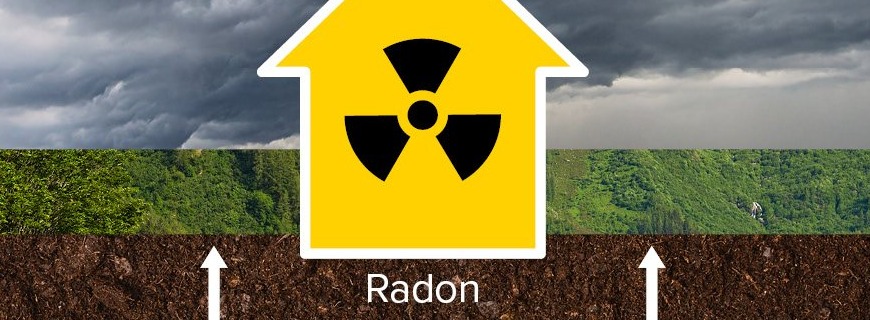
November is Radon Awareness Month
Over two thirds of South Frontenac residents are living with dangerous levels of radon in the living area of their home. And the numbers aren't much better elsewhere in Frontenac and L&A Counties where over 55% are in the same boat.
In 2019, Kingston Frontenac Lennox and Addington Public completed a study of Radon levels in homes across the region. The study showed homes in the region have about a 50% chance of radon contamination that is above the World Health Organisation danger line.
Radon is the second leading cause of lung cancer, after smoking. Lung cancer causes more deaths each year than any other cancer, and cancer is the leading cause of death in Canada.
Testing was done on 1084 homes as part of a survey and information campaign that was initiated in December of 2018 as part of the KFL&A Public Health radon mitigation strategy.
A previous nationwide study by Health Canada in 2009 included only 99 houses in KFL&A. 11% of those tests showed levels about 200 Bq/m³ (Bequerelles per cubic metre – Bequerelles are a measure of radioactive disintegration)
The Public Health study in 2019 was 10 times as large, 1049 homes were tested, and the results were three times as severe. In all of Frontenac County, Stone Mills and Addington Highlands, over 34% of households had levels above 200 Bq/m³. For reporting purposes, the results from Central and North Frontenac, Addington Highlands and Stone Mills were bundled together, as were those for South Frontenac and Frontenac Islands. That gave enough samples in the survey (2% of the households in each survey region) for the researchers to be able to say the results are accurate with a plus or minus range of 10%. The 34% result in Frontenac County, for example, represents a range between 30.6% and 37.6%.
But these numbers, as alarming as they may look, do not capture the entire risk to Frontenac and L&A homeowners.
Erin Hayes, a Public Health Promoter with KFL&A Public Health at that time, was and one of the researchers who worked on the survey. She pointed out that the World Health Organisation (WHO) uses a different measure to determine a dangerous level for radon, 100 Bq/m³.
“The WHO standard is based on the level at which an increased risk of lung cancer can be established, and we have recommended that Health Canada adopt it as a standard since it is internationally recognised and is based on an identified risk,” she said, in an interview at that time.
Using the 100 Bq/m³ standard, 68.9% of households in South Frontenac and Frontenac Islands have radon levels that are unsafe, as do 53.4% of households in Central and North Frontenac, Addington Highlands and Stone Mills.
And on the upper level of risk, 4% of the households in the South Frontenac/Frontenac Island cohort and 7.6% of households in the CF/NF Addington Highlands and Stone Mills have levels that were at the danger level, over 600 Bq/m³
The report made 7 recommendations for action, which include improved health messaging, advocacy, further testing and changes to the building code so new homes are built with the capacity to keep radon out.
In 2019, South Frontenac Township made changes to the rules for new house construction in the township, such that new homes can easily put in radon mitigation measures if dangerous levels oradon are detected.
Radon levels vary greatly from location to location, and the best way to determine radon levels in any home is to test the home over at least a 90 day time period during the winter months. Radon is naturally occurring and dissipates when in open air, but when trapped in a confined space, like a home during the winter heating season when windows are closed, it poses a health risk.
Mitigation is possible for most homes, at a relatively low cost, starting at about $3,000, depending on the location and the kind of construction.
Ty Voigt and Brooks Gee both work in the Radon mitigation business, and since November is Radon Abatement Awareness month, they are holding a public information session on Radon awareness on November 20 in Kingston, at a meeting room at the Cataraqui Community Centre, 1030 Sunnyside Road (401 and Sydenham) starting at 7pm.
They will talk about what they do, and about how homeowners can test for Radon levels in their home this winter, to see if they need to take steps to protect their families.
(see ad on page 6 for details)
There is also good information on Radon available at the Southeast Public Health website (formerly Kingston, Frontenac Lennox and Addington Public Health)