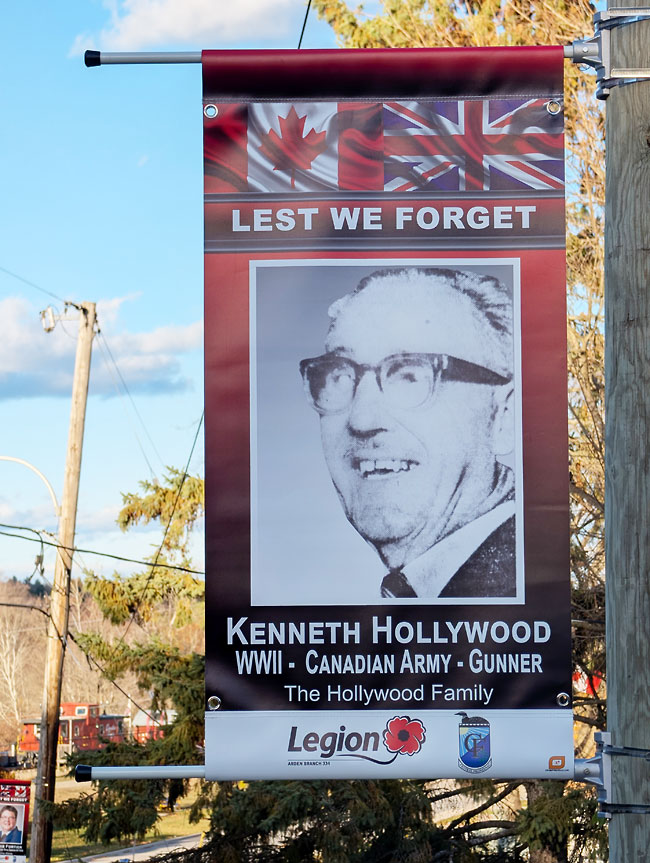
Memorial Banners Commemorate War Stories
This year, the Sharbot Lake Legion joined a number of other rural communities by inviting local families to sponsor banners to fly in their communities in the run up to Remembrance. The Sharbot Lake banners are flying in the vicinity of the Cenotaph in front of Soldiers Memorial Hall.
The Hall is known as the Oso Hall, after the former township, or the Sharbot Lake Hall, 364 days of the year.
But it’s original name was the Soldiers Memorial Hall, in honour of the First and Second World War Veterans who came from the local vicinity.
Some of the names and images on the banners, are men who were the mainstays of Remembrance Day Services in Sharbot Lake through the end of the 20th Century and into the 2000’s and 2010’s. In later years, they had chairs of honour set up for them just in the front.
One of them was William (Art) Goodfellow, who was known as Art, and another was Ken Hollywood.
Art Goodfellow was born in 1925 and died in 2013.
He served in the Second World War from 1942-45 as a flying officer with the 425 Air Squadron. He enlisted when he was just 18 years old and a picture of him as a young soldier is displayed in the front foyer of the Legion. He traveled across Canada while training and ended up in Dartmouth, Nova Scotia where his squadron flew numerous runs over the North Atlantic looking for enemy submarines. He always downplayed his military service, saying that he did not see a lot of action. He joked that “by day we were hunting for submarines and by night-for ladies.”
At Legion events throughout the year, and at the Remembrance Day Ceremony, Art Goodfellow was always sitting with his good friend and fellow vet, Ken Hollywood, who was 8 years older than Art,
Ken’s military career had been more difficult than Art’s.
An article in the Frontenac News upon his death in 2013, talked briefly about his military service.
“The battle of the Falaise Pocket, fought during the Second World War from 12 August 1944, was the decisive engagement of the Battle of Normandy. The battle resulted in the destruction of the bulk of Germany’s forces west of the River Seine and opened the way to Paris and the German border. In those days anti-tank weapons were short range. If the guns did not succeed in first shot kill, their position would be given away and tanks, which hunt in groups of a minimum of four, would then open fire on them. As a result Ken lost three gun crews, 18 men, in support of the third Canadian Infantry Division in France.
Twice during these intense battles, his wife, Ada, whom he affectionately called Babe, received telegrams saying he was dead. After the first telegram proved false, Ada says, she doubted the second telegram, sent after Ken was struck in the head by a bullet.
She finally received a hand-written note saying, “I am alive and well, luv, Ken.”
She never found out until later the extent of Ken’s injuries and how close he came to death. He spent almost two years in hospital after undergoing plastic surgery and convalescence.
Ken lost a brother, Herb, in the Italian campaign and two uncles in the Great War, the First World War.”
But what was the battle of Falaise Pocket?
It took place near Falaise, a town in the Normandy region of France that is about the size of Perth. It is locates south-east of Caen. Aside from being the birth place of William the Conquerer, it is famed for being the location of the battle of the Falaise Pocket.
The Pocket, or Gap was the only escape corridor for the German Army Group B, which was made up of up to 100,000 troops to escape from being encircled by American, British, Polish and Canadian Forces, and regroup with other German forces. Fierce battles had been raging since early August, and starting on August 12, it fell to Polish and Canadian Forces to close the Falaise Gap. Over the next 8 days, tens of thousands of German troops escape through the gap or were killed trying. Casualties on all sides were extensive, but by August 20, the gap was closed, and the remaining German troops were captured or killed.
According to historians, the The Canadians took nearly 5,500 casualties, including 1,470 killed and 177 captured. The 1st Polish Armoured Division listed 1,441 casualties including 466 killed.
Historians differ in their estimates of German losses in the pocket. The majority state that from 80,000 to 100,000 troops were caught in the encirclement, of whom10,000–15,000 were killed, 40,000–50,000 were taken prisoner, and 20,000–50,000 escaped. Elements of several German formations had managed to escape to the east, but they left behind most of their equipment. After the battle, Allied investigators estimated that the Germans lost around 500 tanks and assault guns in the pocket, and that little equipment was taken across the Seine. In a documentary about the battle made in recent year, survivors of the battle, now elderly, still talked about the sights and smells of the battle that destroyed many villages and farms along the rolling countryside and left thousands dead or injured, including Ken Hollywood.
Luckily for Ken, and his wife Ada, with home he was married for 70 years, the battle ended and he recovered his health. He returned home to Timmins, where he was living when he enlisted, and returned to Sharbot Lake to take over the family farm on Shibley Road and Road 38 when his father died. His son Rudy and his wife Joan still live nearby.■