The Shape of The New CAs
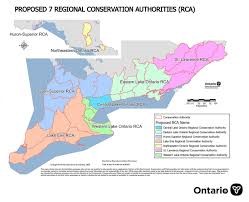
After announcing that the 36 Conservation Authorities (CA) would be combined in order to create 7 large regional organisations, the government of Ontario has released a map and list of the new CAs.
Frontenac County is currently split among four different CAs, reflecting the four watersheds that course their way through the region. Three of the CAs, which make up most of the land mass in the county, will be included in the new CA that is nominally defined by lands where the water flows into the St. Lawrence River. The Rideau Valley CA, headquartered in Manotick, and the Mississippi Valley CA, whose main office is in Carleton Place, make up much of North and Central Frontenac, and parts of South Frontenac as well. Both flow into the St. Laurence indirectly, by way of the Ottawa River. The two organisations have long standing connections, and share some services. The bulk of the municipal portion of their funding comes from residents of the City of Ottawa. Cataraqui Conservation, based in rural Kingston in a co-location with Frontenac County, serves much of South Frontenac. The Cataraqui, drains into Lake Ontario at Kingston, near the start of the St. Lawrence. The Raisin Region CA, which has its headquarters in Cornwall, will also be in the new CA, as will the South Nation CA, which is based in the Village of Finch.
Quinte Region Conservation, which covers territory in the western portions of North, Central and South Frontenac, including Arden and Verona, as well as most of Addington Highlands, has been lumped in with the CAs whose watersheds drain into Lake Ontario, including Lower Trent, Crowe Valley and Otonabee, Kawartha and Ganaraska.
The details about how these changes will be implemented and when, have not been released as of yet, and for 2026 at least the budgets for the existing CAs, are being approved and implemented. Changes to the mandate of CAs has been a constant theme with the current government, and the Premier has identified CAs as being impediments to development in their role in the municipal planning process. CAs are also responsible for water levels within their watersheds. They have also, in the past, played a larger stewardship role, working with lake associations on studies about water quality in the lakes, rivers and streams that flow through this region. ■