Nature Conservancy Picks Up Three More Properties In South Frontenac
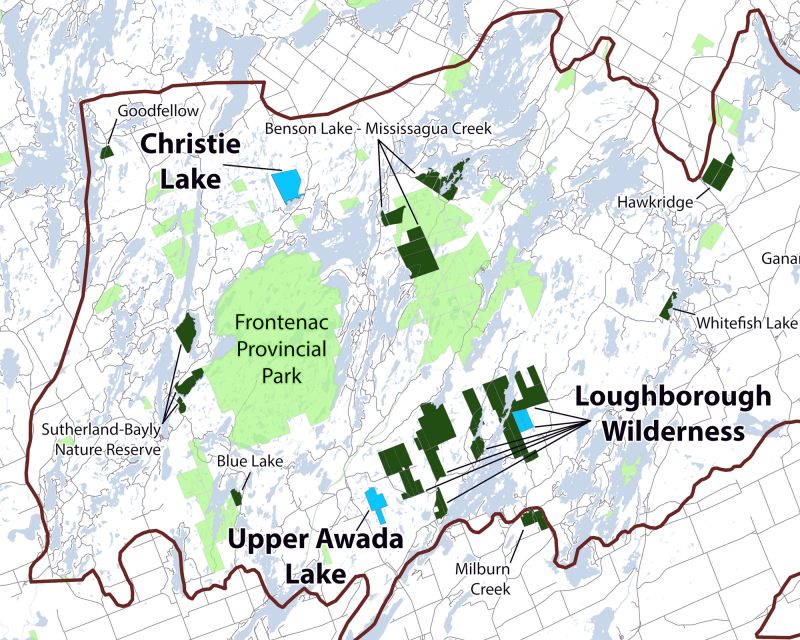
The Nature Conservancy of Canada (NCC) has secured almost 350 hectares of land, in 4 parcels, in the vicinity of Perth Road and Battersea, adding to the preserved lands within the Algonquin to Adirondack Wildlife corridor, as it runs through the southernmost portion of the Frontenac Spur, of the Canadian Shield.
Rob McRae is the NCC Program Director for Eastern Ontario. He has been involved in the development of the NCC holdings in the Frontenac region, and happens to live in Sydenham.
He is quite excited about the new parcels, both for their conservation value and for the role they may play in a secondary function of the NCC, education.
“Three of the parcels are additions to our Loughborough Lake Wilderness area holdings, protecting a lot of habitat in an ecologically diverse region, where we have been working for years. Another, Upper Awada Lake, is located very near Perth Road Village, right off Perth Road in fact, and is not far from the Elbow Lake Environmental Education Centre, which is a site that the NCC owns along with Queen’s University.
And the final property is on Christie Lake, a small lake located off Devil Lake Road, not far from the northern border of Frontenac Park. The combined holdings of Frontenac Park, and the 38 NCC holdings in South Frontenac, create a fairly extensive network of land that is protected from development.
“The Upper Awada Lake project anchors the western edge of the Loughborough Wilderness and bridges two major conservation areas, enhancing landscape connectivity,” said McCraw, “while the Christie Lake property protects 1.2 kilometres of undeveloped shoreline and contributes to a 33-square-kilometre block of intact habitat that connects to Frontenac Provincial Park and other conservation lands. It is also a location that we are considering developing as a trail that can be accessed by the public.”
And the Loughborough Lake additions “expand our footprint in the region,” he said, “protecting high-quality forest and wetland ecosystems and reinforcing a north-south forest core linkage, in eastern North America.
These additional 350 hectares are coming on stream after over 20 years of NCC’s conservation achievements in the Arch.
“The Frontenac Arch connects Ontario’s Algonquin Highlands with the Adirondack Mountains in New York State, forming a vital corridor for hundreds of migratory and wide-ranging species through a network of connected conservation lands. Forests and wetlands conserved by NCC help strengthen the landscape’s resilience and the well-being of surrounding communities. These ecosystems act as powerful carbon sinks, filter water, store carbon and produce oxygen,” said an NCC media release concerning the purchases.
John McCrae said that the NCC acquires holdings in a few ways. In some cases, landowners who would like their land to be protected over the long term, seek out the NCC, and turn over the land for free or at a low price, which is helped out by the charitable status of the organisation, and its ability to provide tax receipts for donations. In other cases, the NDD seeks out properties that come on the market, to enhance their holdings.
The NCC’s goal is to “do more to protect nature, faster” in order to address the “twin crises of rapid biodiversity loss and climate change,” said their release last week.
This takes money, and the NCC seeks out support from the private and public sector in order to finance their purchases. They receive funding support from the Government of Canada’s Natural Heritage Conservation Program and the Nature Smart Climate Solutions Fund, as well as the Government of Ontario’s Greenlands Conservation Partnership Program.
Among private sector supporters, Roots is a major sponsor, as is Grapes for Humanity.
The NCC now has holdings in the Frontenac Arch region of over 3200 hectares, providing habitat based support for a wide diversity of species. Among the at risk or endangered species in the region, are species of turtle that are at risk, including the Blandings Turtle, gray (black) rat snake, eastern whip-poor-will, and many species of song bird, including the cerulean and other warblers. ■