Big Clear Lake spawning bed enhancement project attracts national attention, receives Prestigious Conservation Award
A major win for walleye conservation has landed the most prestigious award ever for Watersheds Canada, the 23-year-old national conservation charity that fosters community-wide involvement in logistically, and often physically, challenging habitat restoration work, even in the wintertime.
On October 3, at the Water Canada Awards in Toronto, Watersheds Canada staff received recognition from nearly 200 water protection leaders. Watersheds Canada’s Fish Habitat Program was the winner of the small project conservation award for an ambitious walleye spawning bed restoration project.
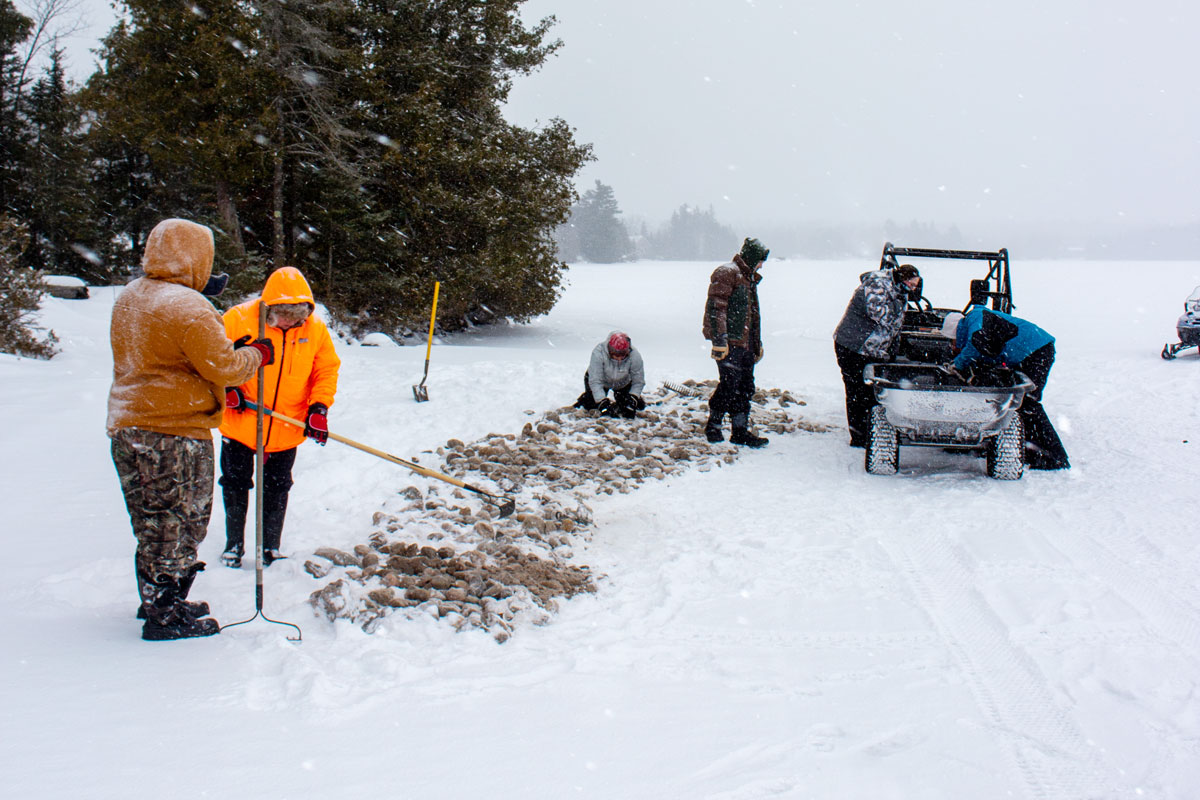
Melissa Dakers, Watersheds Canada’s Habitat and Stewardship Program Manager, praised the cold-weather bravery and resourcefulness of local volunteers who joined her team on the frozen Big Clear Lake last February.
“They brought their snowmachines, ATVs and outdoor stamina and traditional knowledge.”
Chief of the Shabot Obaadjiwan First Nation, Doreen Davis, was in attendance that winter day. “Today is one of those building blocks of your life,” she said after the event. “Today we met new people, we were able to share our energy, our good thoughts, and be on the land and on the lake and work towards something that is important to all of us.”
That day, in partnership with the Big Clear Lake Association, G.E. Matson and Sons Construction, Fisheries and Oceans Canada, and the Shabot Obaadjiwan First Nation, staff and volunteers moved and distributed 17 tonnes of washed river rock overtop a historic walleye spawning bed. The project was funded by Environment and Climate Change Canada’s Environmental Damages Fund, with permits provided by the Ontario Ministry of Natural Resources.
For David Praskey, the lake steward of the Big Clear Lake Association, that February day came about after several years of effort on that particular spawning bed.
“We went out on the lake a few years back to look at the spawning shoals and noticed that a lot of them were encrusted with what resembled brown algae as well as dead zebra mussels,” says Praskey. “We started by cleaning them up ourselves, and then Watersheds Canada got involved.
The first collaborative effort took place in fall of 2023, in which the Watersheds Canada team cleared off silt from the spawning bed using water pumps.
The efficiency of laying rocks onto a frozen lake in mid-winter, and allowing the melting water to drop them into place was something that proved very compelling for the Big Clear Lake and Arden communities, and also brought the Shabot Obaadjiwan and Big Clear Lake into a new relationship.
Praskey said that when the snow melted last spring, it looked like the spawning bed was in prime condition.
“Walleye need clean space between rocks for their eggs to settle and be protected from predators, it looked pretty good last spring, and still looked clean when we looked again in the fall,” said Praskey. “I think it has held up well.”
The association is looking at another location or two, on Big Clear Lake, for spawning bed enhancements in the coming seasons.
“Sustainable native fisheries and healthy lakes and rivers are the true winners of our environmental actions,” said Dakers. “Watersheds Canada is humbled and proud of this national conservation award as it gives our partners and volunteers encouragement to bring more stewardship success stories to freshwater communities across Canada.”
Robert Pye, Executive Director of Watersheds Canada, added, “Our team congratulates the other nominees and winners at Water Canada Awards for their impressive contributions to taking action for and addressing water health issues.”
Watersheds Canada’s Fish Habitat program began 12 years ago and has since delivered 68 grassroots projects, across 44 bodies of water, in Central-Eastern Ontario.
For more about Watersheds Canada, go to watersheds.ca/