South Frontenac Council Rails Against Alto High Speed Train
On Tuesday evening (February 3rd) South Frontenac Council unanimously supported a motion from Mayor Vandewal urging Alto to abandon the South Frontenac corridor.
The motion expressed support for a route running within the City of Kingston.
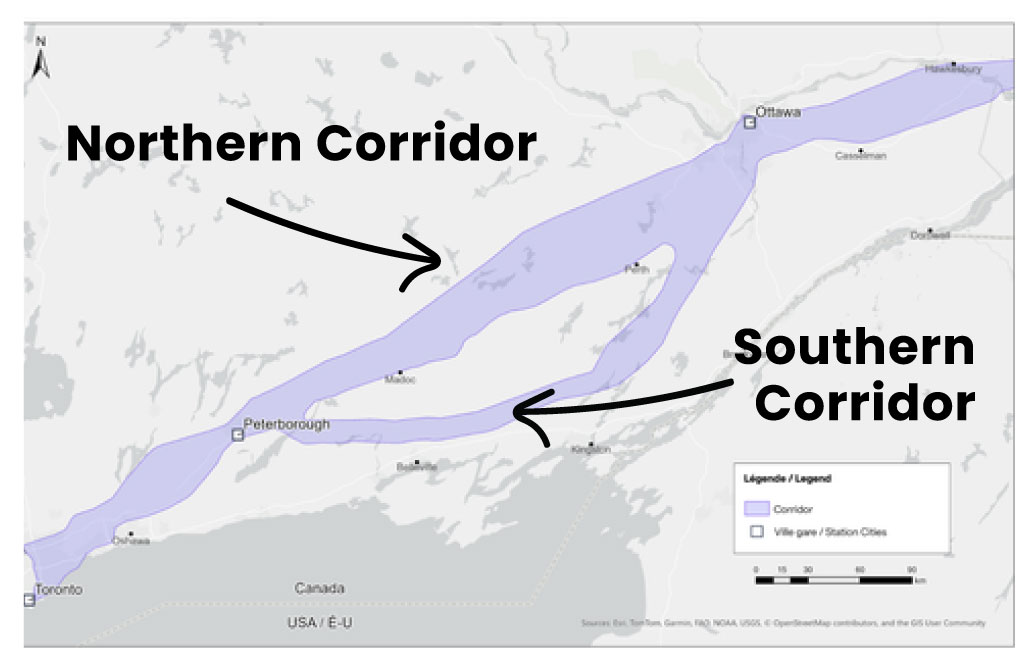
Alto, the crown corporation that was set up a year ago to bring a high-speed rail project from the concept stage to a shovel-ready project for the federal government to approve and finance, put out a map marking out the corridors within which the rail line could be located on January 13.
The map includes a southern route, running through South Frontenac, and a northern route, running through North Frontenac or narrow passage in Central Frontenac. It does not include a route through Kingston.
The existence of the southern option through Eastern Ontario came as a surprise to many, including South Frontenac Council. Alto made a presentation to them in December, without indicating it was a possibility.
Vandewal’s motion reads, in part: “South Frontenac takes pride in its rural character, the protection of environmentally sensitive areas, its agricultural lands and its many natural features including the UNESCO-designated Frontenac Arch Biosphere,” said the motion, adding “with the limited information and consultation that has been provided to date, the Council of the Township of South Frontenac will not support the proposed southern corridor going through its township.
“A better suitable corridor and proposed stop, would be within the boundaries of the City of Kingston, which is the regional urban centre, economic hub as well as the transportation node for southeastern Ontario.”
In speaking to his motion, Vandewal said that he met last week with Bryan Paterson, the Mayor of the City of Kingston, who agreed with his position.
“The City will be considering a motion similar to ours” Vandewal said. “They will support a route through Kingston, only if there is a stop in Kingston. Otherwise, there is nothing in it for them, just like there is nothing in it for us except disruption of our way of life.”
Members of the group, “Save South Frontenac” which is still only ten days old, were on hand at the meeting, and we heartened by Council’s stance.
The group sees real urgency in its quest to organise local resident opposition to the potential high speed rail line, through the township.
“Although it could be a decade or more before this happens, if it ever happens, Alto only has a three- month window for public engagement before they decide on the route. That is why we need to act quickly,” said Katie Koopman, one of the group’s co-founders.
As a response to repeated contact from South Frontenac residents over the past week, Alto will be holding a previously unscheduled information session on February 18 at the Storrington Lions’ Hall, from 11am -3pm, and 5pm-9pm. No registration is required to attend.
“I feel for the people along the potential northern route as well, and everyone who is facing this” said Gord Boulton, the other co-founder of ‘Save South Frontenac’. “They are in the same position we are in. Their community is threatened. For my part, I oppose the entire project. I don't think it will do anything but cost many billions to build, and then lose money if and when it ever starts running.”
Part of the local controversy over the proposed rail line was the result of a Facebook post by MP Mark Gerretson, which was how many people learned about the southern corridor in the first place.
In his post, Gerretson touted the existence of the southern route as a win for the Kingston region, as it would bring the train closer to the City, potentially resulting in a stop for Kingston residents.
He said “it is important to get your voice heard about why you think it's important to get that high speed rail as close to Kingston as possible.”
In its communications with the public, Alto has made it clear that it is not with their mandate to determine where the stops along the high-speed rail route will be. The planned stops (Quebec City , Trois Rivieres, Laval, Montreal, Ottawa, Peterborough, and Toronto) are the only ones they are looking at.
Save South Frontenac is continuing to organise. They are going to the wider public, local and regional politicians, and the community as a whole, to try and create a groundswell of opposition to the southern corridor.
Katie Koopman described the purpose of the group as “a citizen-led committee dedicated to representing South Frontenac residents and the concerns they have about the potential building of a high-speed train in this region.”
The group held a Zoom meeting on Tuesday, February 3rd, to present information prepared by Davies Howe about the changes being proposed in the Expropriation Act in Bill C-15.
Bill-C-15 established exceptions to the Expropriation Act, specifically for the high-speed rail project. It eliminates the need for an initial purchase offer, as well as public hearings. While maintaining the right for landowners to appeal, it shortens the entire process to a short window, limiting landowner's rights.
One of Save South Frontenac's goals is to encourage South Frontenac residents to go to the Alto website, seek out the interactive map of the proposed rail corridors, and pin comments at points in the map where there would be adverse impacts from the line going through.
The South Frontenac corridor runs through Opinicon and Loughborough lakes, crossing Perth Road just before Buck Lake. Sydenham Lake is within the corridor, as are Knowlton and Gould lakes. It crosses Road 38 between Stars Corners (South of Harrowsmith) and a point halfway between Hartington and Verona.
Save South Frontenac has an ally in the Ontario Federation of Agriculture (OFA), who share Doug Boulton’s opinion about high speed rail in general, and his concerns over its impacts in rural Ontario.
“The OFA is highly skeptical that the proposed High-Speed Rail concept will provide sustainable, effective, and efficient transportation with any net benefit for Ontarians. For rural and small towns, it downloads all the associated problems, with none of the ascribed benefits,” said an OFA position paper.
The OFA “is calling for a comprehensive analysis of costs and benefits of the High-Speed Rail proposal, including all costs and benefits applicable to rural residents, communities, and farm businesses.”
North Frontenac Council will also be discussing the potential Alto corridor in their township, when they meet this week.