The Need To Seed: Tips For Seed Starting
t's starting to look like winter might begin to loosen its grip over the next few weeks and you may be thinking of seeding the first plants of the year indoors. The earliest seeds to go into the soil for vegetable growers are often onions, celery and celery root. These vegetables are in it for the long haul, requiring six or more months to grow and need to be started by early March.
While onions can be planted from sets (the little baby onions in mesh bags at grocery and hardware stores in early spring), you can experience greater success when starting from seed. While sets don’t need such an early start and are usually planted straight into the garden, they aren’t available in nearly as many varieties. When using onion seeds however, you can choose from many more sizes, shapes and colours designated by day length: long-day, intermediate-day, and short-day. These daylight requirements strongly correlate to bulb formation, and selecting onions with this in mind ensures your best chance of producing good-sized bulbs. Here in Frontenac, the day length best suited to our latitude is long-day varieties.
Another advantage of using seed over sets has to do with the onion’s life cycle. Onions are biennial. Many people may have noticed that onions left behind in the garden will often return the following spring. If left to grow, they will shoot up a flower stalk topped with a large umbelliferous globe. These are not only some of the coolest vegetable flowers to look at, but they also attract many beneficial insects to the garden. After pollination, the onion drops its seed, the bulb shrivels up, and the cycle begins again.
Keeping this trait in mind, you can see that when starting from sets you are fighting the biological clock of the onion plant. Since sets are already in their second year of growth their objective is no longer “make a big bulb to get through winter,” but rather “hey, it’s time to flower!”and midway through the season you may notice some sets going straight to seed without developing much of a bulb. When starting from seed they are always in their first year of growth and are much more dedicated to bulb formation.
When it comes to celery and celery root the seeds are extremely tiny...think poppy seeds. If you have the option, buy pelleted. This is a natural clay coating that makes the seeds more visible, easier to handle, and helps with germination, which for celery can take over two weeks and sometimes up to a month. During this long germination window, its important to keep seeds consistently moist while using domes over the trays to maintain humidity. Celery needs light to sprout so it’s also important not to bury the seed and instead gently press it into the soil surface.
There are many soil mixes on the market, some of which are specifically designed for seed starting. These often contain higher amounts of sphagnum, coir, and perlite, with little to no nutrients. A readily available option is Pro-Mix Organic Seed Starter, which contains a small amount of nutrients to carry these long-season crops until transplanting. It is also beneficial to add a small amount of well aged homemade compost (about one cup per litre of potting mix) to improve nutrient availability and provide biological inoculation.
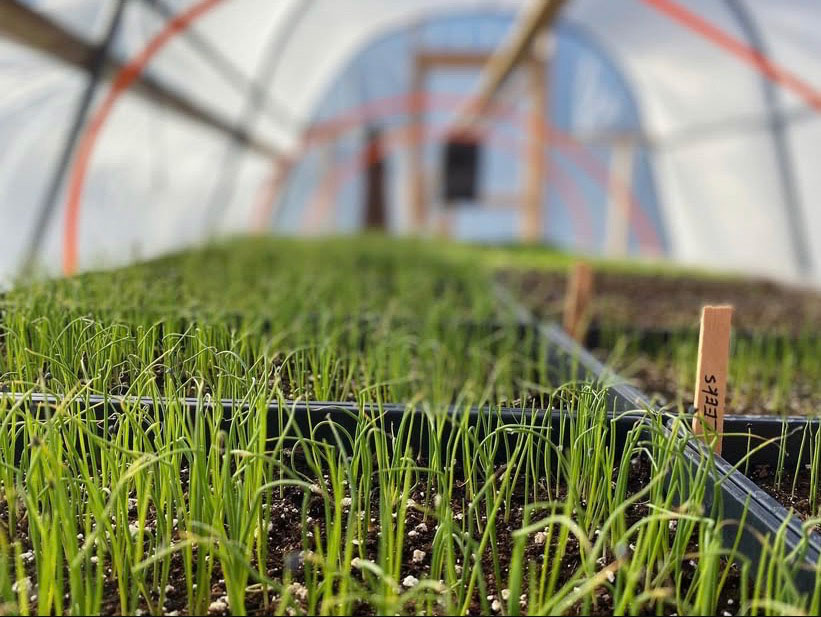
For both of these crops, it is best to seed in open flats (not individual cells). You can fit up to 500 onion starts in an open tray and about 300 celery or celeriac. Simply pack your soil mix firmly into a standard 1020 seedling tray, available at most hardware stores, garden centres, or hydroponic stores. Next evenly spread your seeds on the surface and gently press them in with the palm of your hand to increase soil contact. As mentioned, celery needs to remain on the surface, while onions benefit from a light cover of soil mix or vermiculite.
Once sprouts appear, you can begin a biweekly fertilizing routine. Combine hydrolyzed fish emulsion, kelp extract, and effective microbes in your watering can, following the product directions. This combination provides trace minerals, nitrogen, and beneficial microbes to ensure your plants are off to a strong start. These natural fertilizers can be somewhat smelly, so if you’re starting seeds in your kitchen or living room, you may want to skip this step and instead apply fertilizer just before transplanting. Using a dinner fork or butter knife you can loosen clumps of the seedlings out of the trays and separate them into individual plants. Celery and onions both transplant very well and although it seems rough when pulling them apart like this, once watered into the garden, they recover quickly and begin to grow.
Let's hope the groundhogs are right this year. Here's to an early spring and happy growing