Alto Opposition Ramps Up as “Consultation Period" Winds Down
March 29 has become an important date for a segment of the growing number of groups and individuals in rural Quebec and rural Eastern Ontario who are concerned about the potential impact of a high-speed rail line traversing the landscape in their communities.
Alto is the Crown corporation charged with bringing the high-speed rail project to a “shovel ready” state.
On their website, Alto says it has opened “its doors from January to March 2026, inviting you to discover the high-speed train network project and make your voice heard to help meet the aspirations of our communities.”
That time period ends on March 29.
After that, Alto intends to proceed at pace, and intends to narrow down the corridor for the project to 1km. In Frontenac County, there are currently two potential corridors, both of which are about 10km wide.
For Gord Boulton of Save South Frontenac, it is important to make sure that all of the messaging from groups opposed to the Alto high speed rail project in its current configuration, make their voices heard within the public consultation time frame that concludes at the end of the month.
He brought that message to a packed house March 7, as well as a message of solidarity, at the Sharbot Lake Hall on Saturday morning.
He said that Save South Frontenac, which is a six-week old organisation that he co-founded with Katie Koopman, is focussed on stopping the rail project from progressing through both the southern and northern corridors in Frontenac County.
“It would be just NIMBYism if we said, don't do it here, do it up north,” said Boulton, “that's one of the reasons I am here today. We think this is a bad idea in the southern and northern corridors.”
Boulton has been working with a group seeking a total rethinking of the rail plan, by routing it along the 401 corridor with a stop in the City of Kingston.
This plan, which is being championed by Kingston Mayor Paterson, is outside of the mandate of Alto, so the effort to promote it is aimed directly at the general public and the federal government.
The meeting in Sharbot Lake was set up after a request from Ron Couchman, who purchased a 250-acre property across Hwy 7 from Silver Lake, 18 months ago, with a view towards developing a sugar operation and wellness centre.
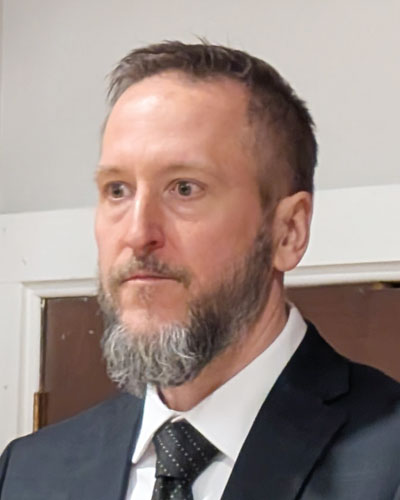
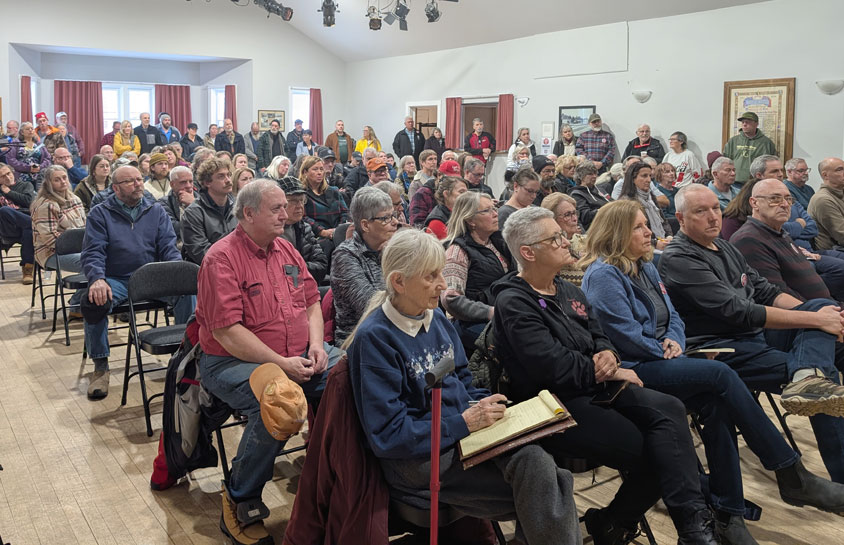
Couchman approached Central Frontenac Councilor Nicki Gowdy, and she agreed to book the hall for the public interest meeting, and to act as the moderator. In addition to Couchman and Gord Boulton, MP Scott Reid addressed the crowd, as did representatives from the Ontario Landowners Association and others. CBC Ottawa’s French service was on hand to provide tv coverage of the meeting.
Ron Couchman said that he learned only recently that his property is located within the northern corridor.
“I know that parts of the property that we now own have been expropriated twice, once for highway 7, and once for a CP rail line, which did not end up going through it, so it is not too hard to imagine they would come through again,” he said, in an interview after the meeting.
His focus at the meeting, and in the days following, has been to seek support and allies in a bid to launch court action to stop the federal government from proceeding.
Much of what Alto is planning to do is justified by its designation as a “project of national interest” . This includes: the aggressive timelines it is pursuing, sidestepping planning and environmental rules faced by other large infrastructure projects, as well as the special exemptions for High-Speed Rail in Bill C-15 (see below).
For that reason, Couchman would like to force the federal government to justify the “project of national interest” designation in court.
He also urged the people in attendance at the meeting to take action in whatever way they could to disrupt Alto.
“We need to make some noise about this project,” he said.
Lanark-Frontenac-Kingston MP Scott Reid talked about both the provisions in Bill C-15, which creates exceptions to the Expropriation Act for high-speed rail, and about the projected cost of the Alto project.
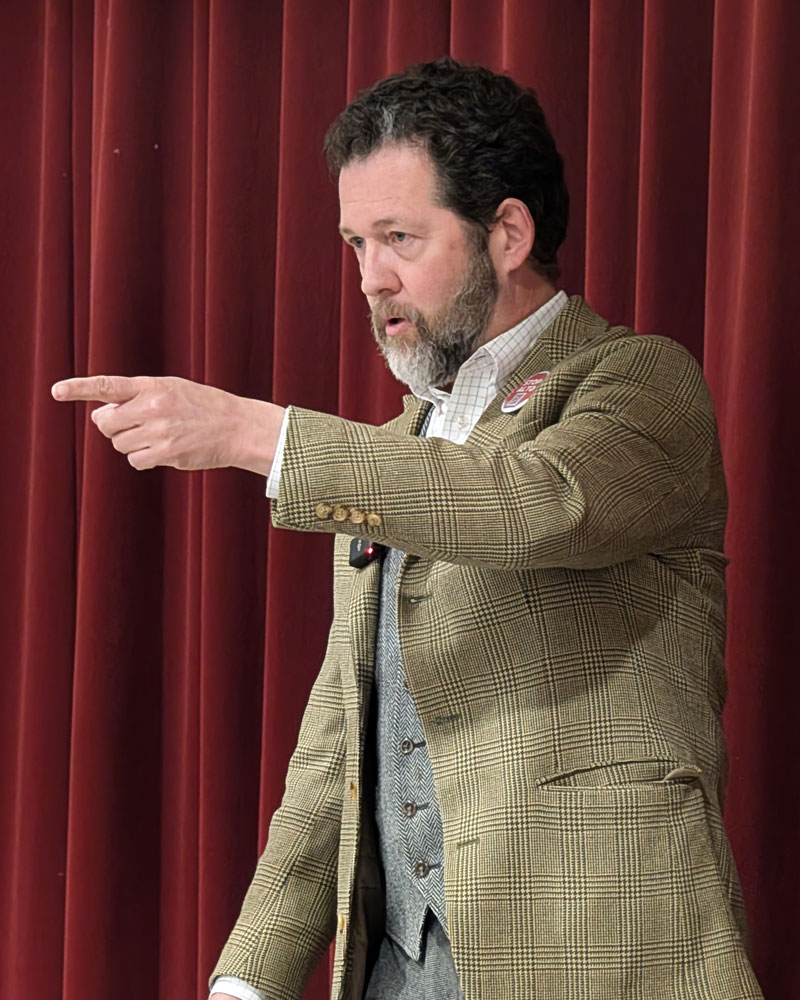
Reid has sponsored a parliamentary petition opposing the project.
In it, he said that “Bill C-15 includes provisions granting the federal government extraordinary powers to designate rail corridors and expedite approvals, planning limiting full environmental review and meaningful consultation with affected landowners, municipalities and communities”.
At the meeting, he added that Bill C-15 grants extraordinary powers over, including the ability to freeze development for four years, regardless of whether the land is eventually required.
As for the viability of the Alto project, Reid said he has his doubts, and those doubts are only intensified by the cost projections offered by Alto.
“They have projected a cost range of $60 to $90 billion. If a contractor provided you with a cost estimate of $60,000 to $90,000 on a home construction job, you would say to them, 'what you are saying is that you have no idea what this project is going to cost me.’”
Reid said that, even though in his research he found that large rail projects, globally, come in an average of 50% over the estimates, he would use $90 billion as the price for the Quebec City to Toronto high speed rail line.
“That represented $9,000 for every Canadian household. That includes people in Nunavut who will never use the rail line.”
The petition has been signed by 9,000 people after just over a week, which is a reasonable number, but Scott Reid said that the numbers need to be a lot higher in order to make an impression.
“To do that, there needs to be 600,000 signatures,” said Reid, and the only way to attract those kinds of numbers would be for opposition to Alto to expand from its rural base to the cities.
One member of the audience, Lanark-Frontenac Kingston Conservative Riding Association member and former Central Frontenac Council member Brent Cameron, said “there are 50,000 cottage owners in Eastern Ontario, most of them living in cities. Approaching the lake associations is a good way to get those people informed about what is going on.
The presenters at the meeting took questions from the audience, and each of them had a different call to action.
After the meeting, Ron Couchman said he was okay with the differences of opinion among presenters about what tack to take, in response to the threat of expropriation in local communities.
“I think that is fine. We needed to give everyone a chance to express themselves, the audience as well as the presenters. I've been to all of the Alto meetings, and they are not consultation exercises as much as information sessions. People need an opportunity to provide real input. This is a threat to all of us.”
Groups are in opposition to Alto across Eastern Ontario and Quebec, and there is ample information on social media about the project, in addition to the information on the Alto website.
When contacted after the meeting, Katie Koopman of Save South Frontenac said that, based on how difficult is has been to get pertinent information from Alto officials, she thinks Alto will retreat from the public eye at the end of March, and will surface in 8-12 months with a final corridor, and will be very hard to oppose at that point.