Controversy Over Frontenac AI “Ag Influencer”
The Frontenac Farming community is not happy with a Central and South Frontenac tourism promotion campaign, targeting Instagram and Tic Toc users in Montreal, Ottawa, and Toronto.
The program, the first of its kind in Frontenac County, initiated on April 1, was designed to promote agri-tourism in the county. It was designed to both support and capitalise on the social media skills of a new generation of Frontenac farmers, who market their products with lifestyle-oriented content on their social media feeds.
Jim McCrew, Chair of the South/Central Frontenac Economic and Tourism Development (SCFETD) said “because our committee has minimal funding, we have to be creative, but we wanted to work with the local farm community to promote local food for residents and tourists alike, now that the Open Farms events have gone by the wayside.”
Open Farms was a fall event that was initiated by Frontenac County, in partnership with the City of Kingston, in 2018. It changed form over the years, and after the 2025 edition, Frontenac County decided to pull the plug.
“We know there is now a core group of farmers and local food producers who understand the power of social media, especially Tic Toc and Instagram, to promote their products and the lifestyle in Frontenac County. This kind of promotion is pretty much organic, and it also promotes new people moving into the region to start new farms, so we thought it could be a win-win.”
Then uptake from the local farm community to become influencers was not what the committee had been hoping for, however, which led them down a path that has led to controversy.
Justine Barnett, a SCFETD member from Battersea, explained what happened next.
“When we talked to them, they said all they were farming now was snow, and that was going to be followed by mud. They said to call them in mid summer. We did not want to give up on our spring promotion campaign, because we know it is good timing to promote summer tourism in the spring, and since I have been using AI tools in my own business, I headed up a small group who used AI to create influencers.
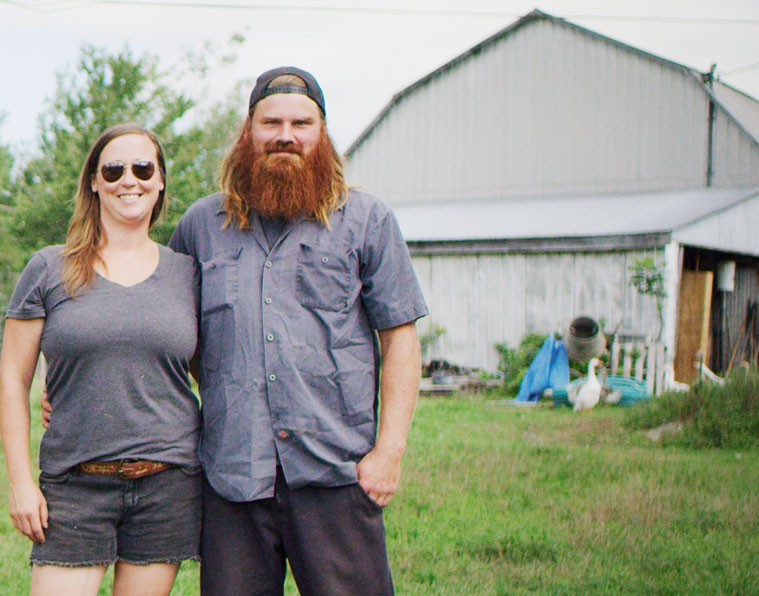
The first video went up on Tic Toc on March 17, and the first Instagram story went up on the 21st, “the first day of spring,” said Barnett.
There were two Frontenac AI farmers, one female and one male. The male was named Matthew Petrarch, and the female Amalia Ciobanu, was conceived as being of Romanian heritage. They are a couple, engaged in mixed gardening in Frontenac County.
“I think it was the Romanian heritage element to Amalia that started us down an unfortunate path,” said Barnett,
After the posts went up, word started trickling back to the SCFETD that the “Fab Frontenac Farmers” as the two influencers were branded in all the posts, did not appear to be farming “infrontenac” at all.
The AI program placed them in Romania instead of Ontario, and it made the time of year mid-summer. Romania has a very strong farming industry, with a large workforce. Twenty six percent of Romanians make at least some of their living through agriculture. Many of the images in the posts are consistent with garden plots everywhere, but when shots of the landscape are included, it is clearly not a Frontenac County landscape.
“The AI tools had a lot of material to work with, and they did a great job for us,” said Barnett. “But it did not read as Frontenac.”
In fact, complaints came in early, and often.
“People do not like the AI aspect, and they wonder why the countryside looks like it is somewhere else. I thought it looked like Frontenac in summer, except maybe for the mountains,” said Barnett. “once people complained, I fixed it, of course, and locating them in Frontenac County.”
The damage was done, however.
“The SCFETD met early this week, and although we appreciate the good intentions of the subcommittee we have decided to pull all the social media posts and cancel the Influencer Program for now,” said Jim McCrew.
“It is a shame,” McCrew added, “that the entire Influencer strategy cannot be pursued, because we think that over time we could have had success, and the local farm influencers would have benefitted from that, but nervousness over AI tipped the balance for us.
“Once it came out that the influencers that we used to start the program are not living farmers, that they are AI generated, we were concerned that the public might think the real farmers are not real, and we did not see how to combat that.”