It's Back! ... Hartington Subdivision, The Sequel
South Frontenac Council is holding its first meeting of April at an unusual location, the Verona Lion's Hall, which would be odd considering that the township just finished updating its office and council chamber a few months ago.
But the change of venue is recognition that there are two items on the agenda that are of particular interest to residents of Portland ward, the requirement for a phase 3 archaeological study for the Verona Housing Project, and a more contentious item, phase 2 of the Hartington subdivision.
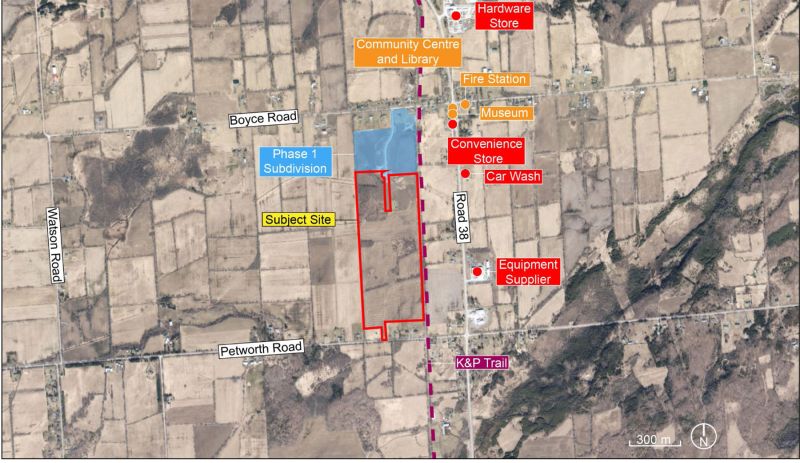
Developer Terry Grant came to Council in the mid 2010s, seeking to develop a subdivision to create new building lots and extend Hartington along Petworth Road, and the proposal sparked significant push back from surrounding property owners, over environmental impacts, effects on the water table, and more.
Grant and his land use consultants Fotenn, ended up dividing the proposal into two phases, in an attempt to get at least a small subdivision approved. Council rejected the proposal for phase 1, a 13 lot subdivision. Grant appealed the decision to the Ontario Municipal Board (OMB - which has since been replaced by the Ontario Land Tribunal) and late in 2018, the OMB sided with Grant, and the subdivision was approved.
When the proposal was divided into phases, opponents said that if phase 1 was approved, it would only lead to phase 2.
Now, eight years later, the proposal for phase 2 has reached the public meeting stage. By holding this week's meeting in Verona, South Frontenac Council is providing easier access to the meeting for Hartington residents. There is also more room at the Verona Lions Hall than there is at the council chamber in Sydenham. At every meeting dealing with phase 1 back in 2016 and 2017, the crowd spilled out of the council chamber onto the sidewalk.
At this week's meeting, township staff are presenting information regarding the proposal, which would create 34 additional lots, if accepted as presented. Staff are not providing any recommendations to Council at this time, but will be outlining how the proposal has been presented to them, and what studies have been completed thus far.
The approval process contains three components. In order to be approved, there will need to be zoning bylaw amendments and Official Plan amendments, which are both under the purview of the township, as well as a Plan of Subdivision, for which Frontenac County is the approval authority.
Water was a major issue in the first phase of the project. A hydrogeological Assessment Brief has been completed for phase 2 by ASC Environmental, and concluded there is sufficient water for 34 wells. Issues with elevated dissolved solids, chloride and sodium in test well water can be addressed through treatment, according to the brief. Frontenac County is having the study peer reviewed by a third party consultant.
Another issue that will need to be addressed is the fact that much of the land that needs to be re-zoned as residential and included in the Hartington Settlement area, is currently zoned “prime agricultural” while a small portion is in an “environmental protection” area. There is a provision to re-zone prime agricultural land where the soil is of low quality, and the consultants have prepared a soil survey that has determined that the soil is class 4 or below. The inclusion of the lands in question as “prime agricultural” took place by provincial directive when the recent township Official Plan was completed. This was done because the property is located in the vicinity of other prime agricultural lands, not because of its own value as farmland, according to the consultants working for Terry Grant.
The consultants also said that the environmental protection came about because a woodland area was mistakenly identified as a wetland.
The studies supporting the re-zoning application are also under review by Frontenac County.
The consultants for the project also looked at the potential for communal servicing in the proposed subdivision, but rejected that for cost factor reasons, and because the1 hectare lots that would be created, are large enough to accommodate their own well and septic systems.
The report to Council, which was written by Manager of Planning Christine Woods, and approved by Director of Development Services Brad Wright and Chief Administrative Officer Louise Fragnito, concludes that the “the draft plan of subdivision will require further review and approval before the development could occur.”
Once public comment is heard and registered, Staff will look at the studies and the comments, and the peer reviews and comments by outside agencies. Only then will Staff prepare a final report and make a recommendation to Council for or against approval of the township portion of the project, while Frontenac County planning staff will do the same for the benefit of Frontenac County Council.
The rules of appeal have changed, limiting who can appeal to the Ontario Land Tribunal.
Verona Housing
In the phase 2 Archaeological study of the property where the Verona Housing Project is proposed to be constructed, a 19th century site in the northeast corner of the development site, containing a total of fifty-five 19th century artifacts was identified. Not only will this require a $102,000 stage 3 archaeological study to retrieve artifacts from the site, but it freezes development for a 70 metre buffer zone around the site where the artifacts were found.
This buffer zone includes areas within the planned building envelope. The township is applying for approval to work outside of the 70 metre buffer zone before the next phase archaeological study is complete, which is projected to be late fall of this year.