Save South Frontenac Takes Stock, And Looks Forward
About a month ago, as the first end date for the Alto rail corridor consultation process was approaching. Save South Frontenac (SSF) Founders Gord Boulton and Katie Koopman, along with their key team members, were thinking about what was next.
They knew that the efforts of Save South Frontenac had been to have maximum impact on Alto. The organisation, which was founded in early February, had been remarkable successful getting the word out locally and regionally about what they see as an existential threat to the well being and way of life in South Frontenac if high speed rail comes through.
They hosted public meetings and pin parties to make sure every relevant concern and threat, to schools and turtle and farmland and communities, is recorded on the Alto. They made sure every institution that is active in the region, from councils to not for profits and beyond, took a position about the project.
But what were they to do when the consultation phase ended?
Their planning was delayed when consultation was extended until April 24th, and they made use of that time to not only continue to participate in the prescribed process, but to prepare for the next phase.
That phase began last Wednesday night at the Storrington Hall, at a gathering attended by local residents and politicians, Save South Frontenac members, Facebook group facilitators and members of affiliate groups from Rideau Lakes, Lennox and Addington, and beyond, as far away as Peterborough.
The occasion was partly a celebration of all the work that has been done, there was cake and coffee, and partly a chance to evaluate where things are now and where opponents of the southern corridor (and the project as a whole) should focus their efforts.
The meeting started with Josh Suppan, who was there as an expression of solidarity from the National Farmer’s Union. Suppan is a local farmer and President of the National Farmers Union – Ontario, and Andrew Hyett, a geologist and researcher who has worked with Save South Frontenac and others over the winter, and compiled a research website of his own
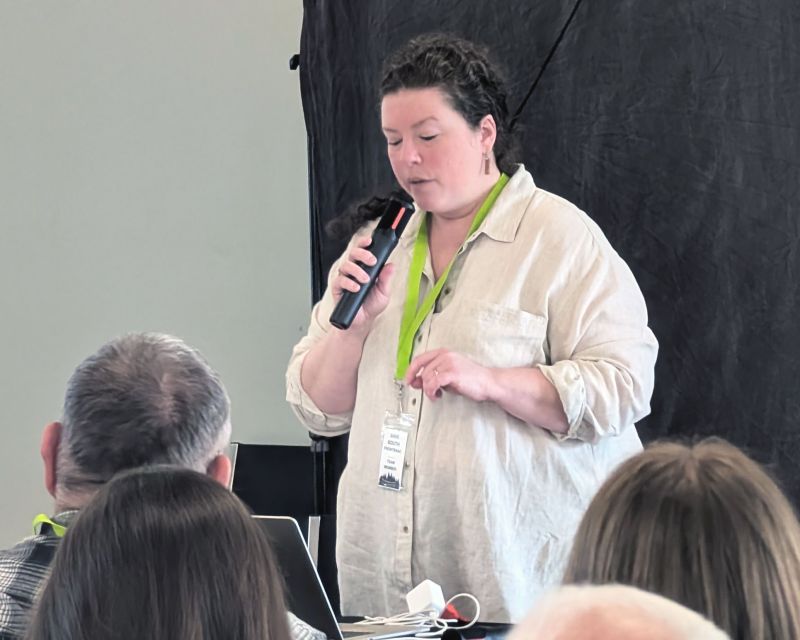
Then, Katie Koopman and Doug Bouton came out to present Save South Frontenac’s “Three Month Summary Report” which is available for download at savesouthfrontenac.ca.
The report is about 35 pages long, and is accompanied by 6 appendices. The report was prepared in order to detail the activities of the group and the outreach it has undertaken, and the issues of concern with the southern corridor proposal that Alto was seeking feedback on.
It provides a summary of environmental considerations, socio-economic considerations, agricultural impacts, and impact on municipal infrastructure.
The analysis in the document leads to the conclusion that the background work to deal with all of the potential and actual concerns of the South Frontenac community has not been done by Alto, and the project is not ready to proceed to selecting route.
“In summary, the proposed corridor represents a multi-dimensional change to South Frontenac’s physical, environmental, and socio-economic system ... The concerns outlined in this report, raised by community stakeholders including Save South Frontenac, highlight the need for a more comprehensive and locally informed planning process that fully accounts for the unique characteristics of rural municipalities,” the report says.
Although SSF was created in order to represent the interests of South Frontenac residents, much of what is included in the report, and certainly conclusions, apply for the northern corridor, and every location that Alto is looking at.
The report lists 7 principles that will be promoted to Alto, and to the federal government, in the coming months.
Of them, the first is specific to the South Frontenac, but the other 6 apply in most rural locations along the route.
The 7 principles are: “Do not route through South Frontenac, protect agricultural land and food production, safeguard rural tourism and the outdoor economy, respect environmental sensitivity, minimize expropriation and community disruption, protect road connectivity and public safety, and prioritise appropriate station locations.
The report also asks Alto, or the federal government that oversees its operations, to consider “the broader transportation f or Eastern Ontario be revisited to ensure alignment with regional needs. Consideration should be given to whether a reliable, frequent, and well-integrated conventional or higher-speed rail system may better meet mobility goals than a fully high-speed system, particularly in areas not directly served by stations.