The Village Blacksmith in 2026
In the 18th and 19th centuries, blacksmiths were vital members of local communities. Primarily using wrought iron, they toiled in the forge to create and repair tools and implements essential for farm, industrial and home use. With hammers, anvils and tongs, they bent, cut and shaped hot metal into horseshoes, chains, sickles, bolts, hinges, hooks, candle sticks, wheel rims and much more.
Today, many of these items are mass produced. Is there still a place for a blacksmith in 2026? The answer is: Yes.
Although rarely using a traditional coal-fired forge, local blacksmith and metal fabricator, Stefan Duerst, still employs the seven basics techniques of blacksmithing to craft architectural and ornamental pieces for today’s world.
Born and raised in Munich, Germany, Duerst completed an apprenticeship in metal design, fabrication, and blacksmithing as well as earning his Masters in Metalwork with distinction. In between schooling, he worked under a Master Blacksmith whose ability to realize just about anything he imagined in metal greatly inspired Duerst.
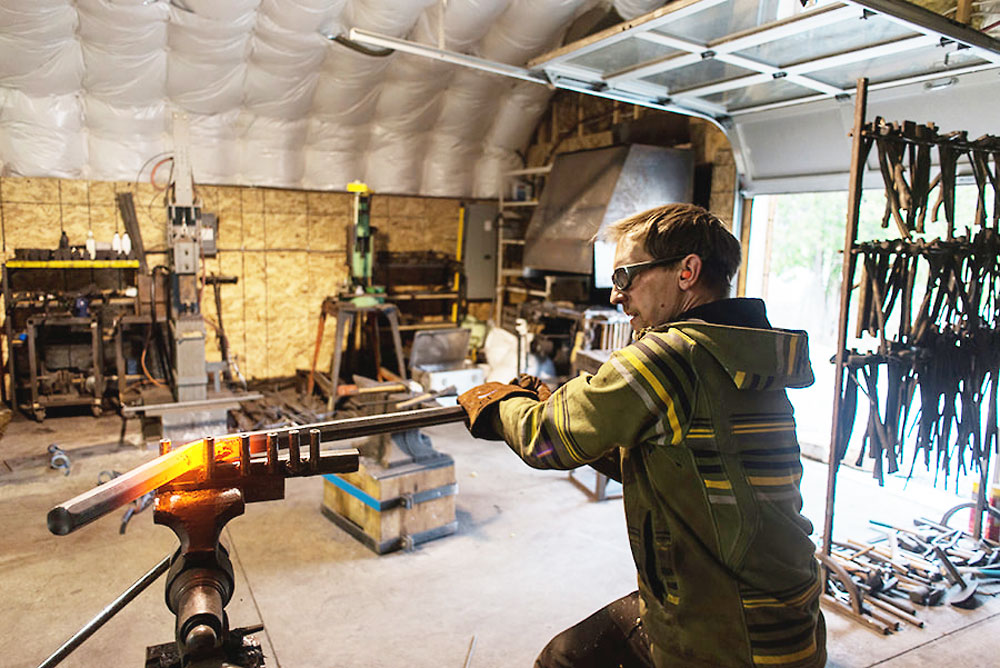
From his studio in South Frontenac, he produces architectural pieces for home and garden. In a recent visit to his studio on Buck Bay Road, a staircase and a balcony railing were in progress. His website (www.duersthfm.com) offers examples of home décor, furniture, lighting fixtures, garden art, gates and hardware.
As well as producing such functional pieces, Duerst also creates artistic works that have garnered international praise. His sculptures are displayed in highly-regarded galleries in Canada and beyond.
Stefan Duerst will be offering a glimpse into the role of contemporary blacksmith in a presentation at the South Frontenac Museum, 5595 Road 38 in Hartington on Saturday, May 16th at 2:00pm. Admission is by donation. Stop by and learn how traditional blacksmithing techniques have evolved into metal fabrication practices that produce practical and ornamental items for the modern world