Sharbot Lake 150th Anniversary
It was an event that took 150 years to arrive, but without the efforts of a group that has been organising for the last 2 years, it would have passed without notice.
On May 8, 1876, the first K&P rail train gently crossed a brand-new causeway over the narrows between the two basins of Sharbot Lake, reaching the early incarnation of a railway village on the north side. At the time, this was as far as the optimistically named Kingston to Pembroke Railway had reached, and the train had to turn around and head back over the new causeway.
The K&P railway never did make it to Pembroke, but it did eventually make it to Renfrew, 120 kilometres from Sharbot Lake but 60 km short of its initial destination.
That first crossing into Sharbot Lake marked a turning point in local history. Between the construction of a turnaround and a station, and the coming of the east-west CP rail line in 1884, the village of Sharbot Lake was built-up over a ten-year period, between the mid 1870s to the mid 1880s. The train enabled local farmers to get produce to the Kingston market, although the realities of farming on the Canadian Shield were a limiting factor, and it was a boon to the local mining industry.
The momentum stalled as the 20th Century approached, and then everything changed after WW1, with the introduction of automobiles as the primary mode of transportation.
Sharbot Lake Village History Group, made up of John Lee, Nelda Whan, Sharon MacDonald, Gene Kirkham, Ann Walsh, and Dianne Lake, met for the first time in the spring of 2024, and when they started looking at putting together displays about the history of Sharbot Lake for the 150th anniversary of the opening of the causeway to rail traffic, they leaned on the work done previously by the Sharbot Lake Historical Society, which was led for many years by the late Shirley Peruniak, Doris Ayers, and Jessie Donelly.
“We all have an interest and love for our village of Sharbot Lake. Some have a long family history of generations, who have lived and worked in the village,” said Dianne Lake on behalf of the group.
The two-year effort resulted in a number of outcomes, which were all captured on May 8.
An event marking the 150th anniversary took place in the Sharbot Lake Hall between 9am and 5pm, on both May 8 and 9. Much of the contents of the display are included in the History of Sharbot Lake VIllage book that was selling briskly all day.
“The book starts with the purchase of 95 acres from the Crown by Mathhew Garrett in 1875. Matthew Garrett was killed in November 1876, within 6 months of the causeway going through, after a scuffle at the inn and rooming house he had built near the current Sharbot Lake beach. He was survived by his wife Elizabeth, who eventually sold off the property, mostly to Mercy Thomson and Melzar and Vincena Avery. Eventually 124 lots were created, and the first part of the book looks at the houses in the hamlet now, and what was in that location before. The second part looks at some of the historical photos and the commercial buildings that capture the history of Sharbot Lake, and the last chapter looks at the floating and pile bridges.
The cover of the book is one of the two surviving photographs of Sharbot Lake Village in 1876.
The displays in the Hall featured the book, and much of the source material that was used, along with a display board that was prepared for the occasion, and is being offered to Central Frontenac Township for mounting in the hall.
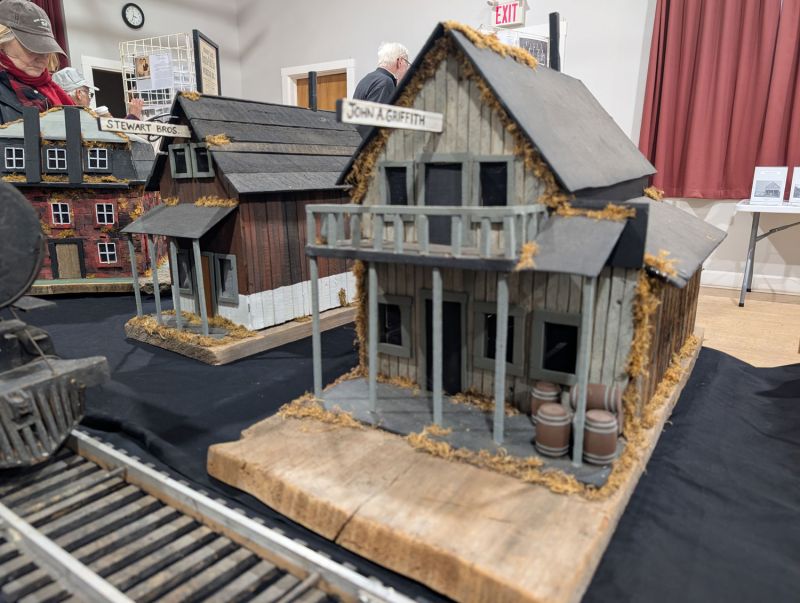
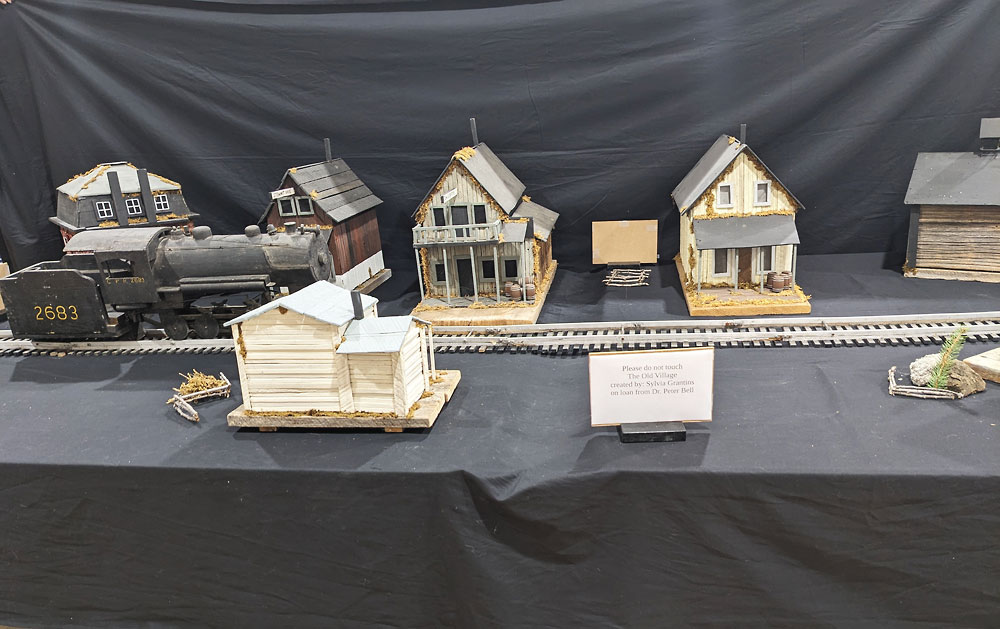
There was also a table filled with miniature buildings, based on the source material, along with a model railroad and track.
The miniatures are part of a collection that was commissioned by Peter Bell, sometime in the 1990s.
“I was visiting Shirley Peruniak one day, when I saw she had a couple of pieces by Sylvia Grantins, a local artist. They were faithfully rendered miniature log cabins that Sylvia had made. I contacted her and commissioned miniatures of the historical buildings from Sharbot Lake,” said Peter Bell, who came out to the hall on Friday to see the exhibit.
Sylvia Grantins left the area around 20 years ago and now lives in Kirkland Lake, where she continues to make art.
The organisers invited Mr. Stott’s history class from the Granite Ridge Education Centre to see the display at the hall.
“The students were engaged and interested in the display and the history,” said Dianne Lake. “Some found homes they had lived in, or grandparents had lived in. The story of Matthew Garrett and his adventures and murder in the village was an eye opener for many of them.”
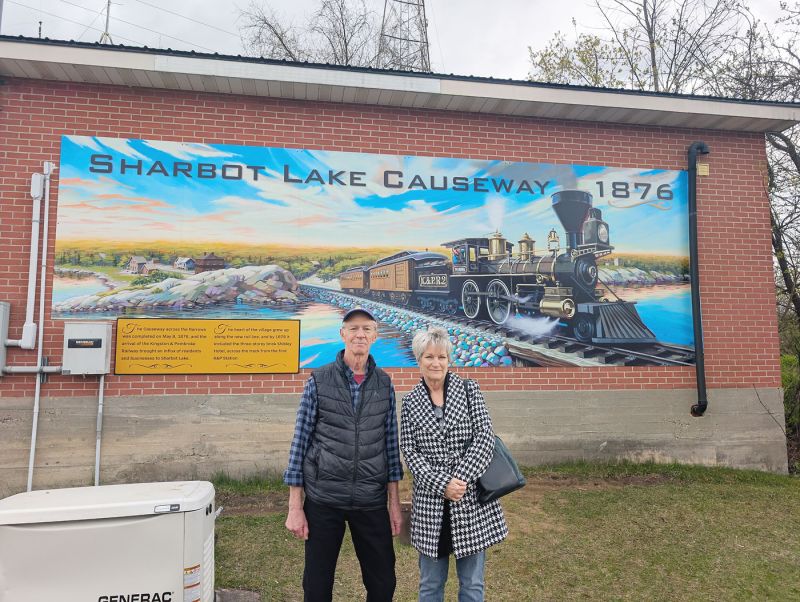
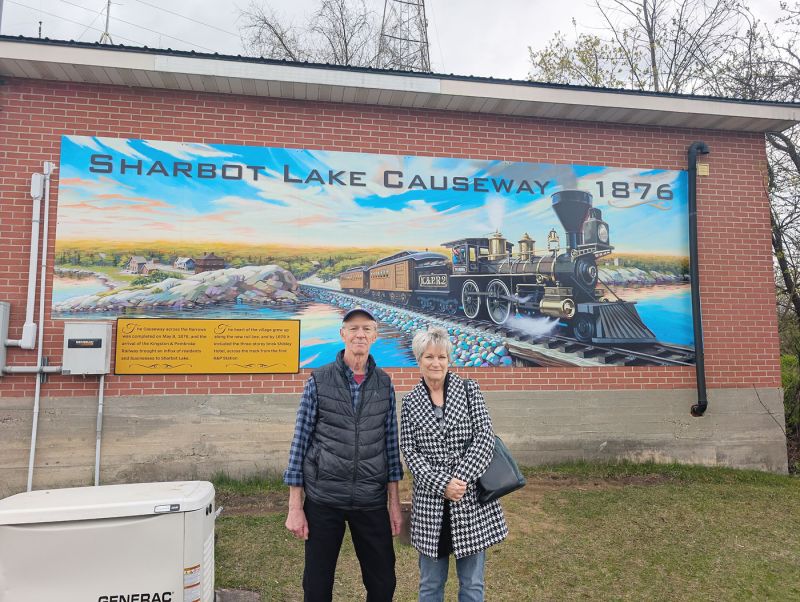
In addition to the display at the hall, there are two more permanent installations marking the 150th anniversary. The Central Frontenac Railway Historical Society has been working to bring a new caboose to their railway heritage park, on Elizabeth Street, and it happened to arrive a week before the celebration on April 30. The Historical Society also did something more directly aimed at the anniversary. It sponsored a mural depicting the first train that crossed over the causeway. Dereck Redmond of the historical society provided the research and local artist Donna Larocque painted the mural. There was no photo taken of the first train to cross the causeway, but there was a photo of a later trail, and that is what she used.
The mural was dedicated at a ceremony in the afternoon. It has been installed on the North Frontenac Telephone Company building at the corner of Elizabeth Street and Road 38, facing Mathew Street.
After the dedication ceremony, the exhibit at the hall remained up for the rest of the day and on Saturday May 9. It will be remounted on the weekend of August 7 and 8, so the seasonal resident community will have a chance to view it.
“From the time the doors opened until we closed, we never had a moment that someone didn’t drop in, and some folks stayed for hours,” said Dianne Lake.
She added that the committee owes a big thank you to Central Frontenac Council, Dr Peter Bell, Susan Wing, Donna Larocque, Sara Carpenter and the library, 1010 Garden Centre, and Sharbot Lake United Church for their support. She also thanked the members of North Frontenac Little Theatre who dressed in vintage outfits and graced our hall and village, and Bill MacDonald and Alvin Lake for all the help setting up the display.
The books are available for sale, for $30 each. Please call Dianne (613-279-2991)