South Frontenac Community Wild Land Protection Plan
The smoke that has resulted in air quality warnings across the region and well beyond, over the past ten days, is a stark reminder of the devastating impact of wildfires. Last summer was one of the driest in recent times in Eastern Ontario, and wildfires were a local concern. Luckily this has not been the case so far this summer.
At a meeting of South Frontenac Council last week, the consulting group Loomix presented a report on wildfire response in the township. The report was commissioned in order to provide background information and the framework for a “Community Wildland Fire Protection Plan” to align the township with “Community Wildfire Planning Guidance” that has been issued by the Ministry of Natural Resources.
The report talked about what happened in the township last summer.
“In 2025, the South Frontenac Fire Department (“the Department”) responded to 43 calls related to open-air burning incidents.
“The Department also responded to 20 burning complaints, despite the fact that South Frontenac was under a total fire ban for 91 days. A significant wildfire occurred in August. This incident was due to farming operations, which caused an agricultural fire that consumed over 20 acres. Over 50 firefighters from South Frontenac, Stone Mills, and Kingston assisted in combating the fire while the Ontario Provincial Police and South Frontenac Roads Department managed multiple road closures, on a busy summer Sunday.
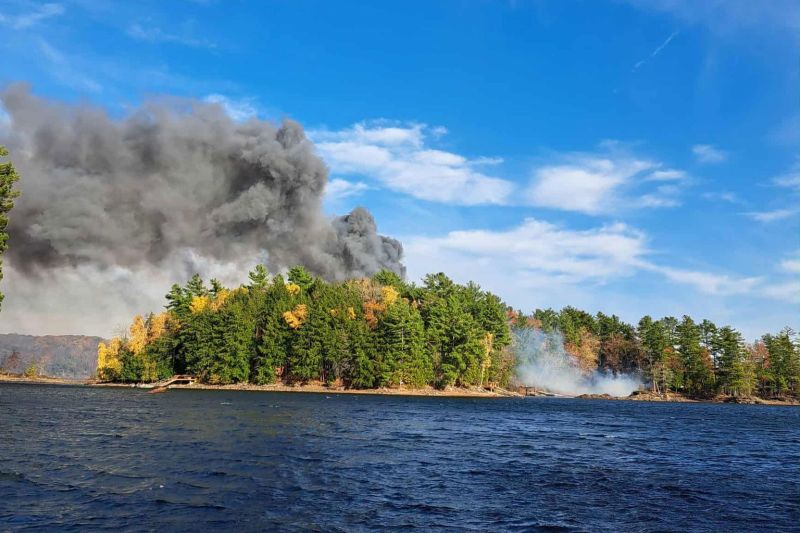
“Another significant fire occurred in October. This fire started on an island, and it required approximately 40 firefighters from South Frontenac and Central Frontenac to handle the response. Those firefighters used three marine units and multiple wildland fire pumps over a two-day period. The outcome of the fire resulted in the destruction of four seasonal dwellings and an estimated loss of $2.4 million. Twelve cottages were saved, and no lives were lost”.
The detailed report contains information around education, processes that can make the township more able to respond quickly to wildfire threats in terms of communication and response, and increasing the capacity of the fire department to respond. It includes a long list of recommendations, some of which would result in increased costs, and others that can be incorporated into township operations with little impact on the township budget.
Councillor Norm Roberts said that “education is the most important thing about this document, and also the township should figure out some way of collecting brush.”
Mayor Vandewal pointed out that brush is accepted, free of charge, at the Verona waste site, and Roberts said this was fine for people living in that part of the township but did not help residents in Storrington. Vandewal said the service is open to everyone in the township.
Councillors were concerned that if they adopted the plan, it would effectively commit the next council to significant spending, but Chief Administrator Fragnito said all they were being asked to do is to receive the plan and refer it to Staff to come back with an implementation plan.
Mayor Vandewal said that when Staff bring that plan back, “could we see which measures are legislated and which ones are up to us to decide to adopt or not, because as far as I understand, all we are required to do is education. We do more than that, of course, but that is up to us.”
Township Fire Chief Del Blakeny said that the township has already been successful in obtaining grants to help wildfire response, including a $15,000 grant to fund the Loomex protection plan document, in addition to grants for wildfire suits, helmets, and boots for members of the department.
The township also has an emergency preparedness website as part of Southfontenac.net, which includes information about how to protect homes from wildfire risk, and a link to FireSmart Canada, a national website about keeping homes as safe as possible from wildland fire risk.
The Loomex Plan was received