Zach Dunn Shares Global Veteran Stories
Zach Dunn did not know much the war story of his maternal grandfather, John Williams, who was a World War 2 vet. John lived a long life, and died when Zach, who is now 26, was a young child. About five years ago, Zach decided to learn whatever he could about his grandfather’s military service. John enlisted in the British airforce when he was 18, as a paratrooper. He served in Africa and Germany between 1939 and 1945.
This personal research project compelled Zach to want to make sure “the stories of World War 2 (WWII), Korean War and Vietnam War Veterans are documented to help preserve the legacies and names of these veterans forever,” according to his website – rememberingcanadasveterans.com
Whenever he has time, Zach travels around Ontario interviewing WW2, Korean War and Vietnam War veterans, and captures their story through story, picture and video.
He contacts whoever he can, including Legions, veterans hospitals and other organ isations for leads, and then heads out on weekends to collect stories.
That’s what he was doing last weekend.He was headed to Kingston to interview James Lorimer Kierstead, who lives in Kingston but has a strong past connected to Sharbot Lake. Zach was in touch with Bill Wilson from the Sharbot Lake Legion, and Wilson told him about Lloyd Arnold, a Korean War vet and transplanted Crow Lake resident who is a prominent member of Sharbot Lake Legion Branch 452 Arnold just recently received a Quilt of Valour at the annual Sharbot Lake Legion Awards ceremony this past June.
Here are some excerpts from the stories Zach gathered from Lloyd Arnold and James Kierstead.
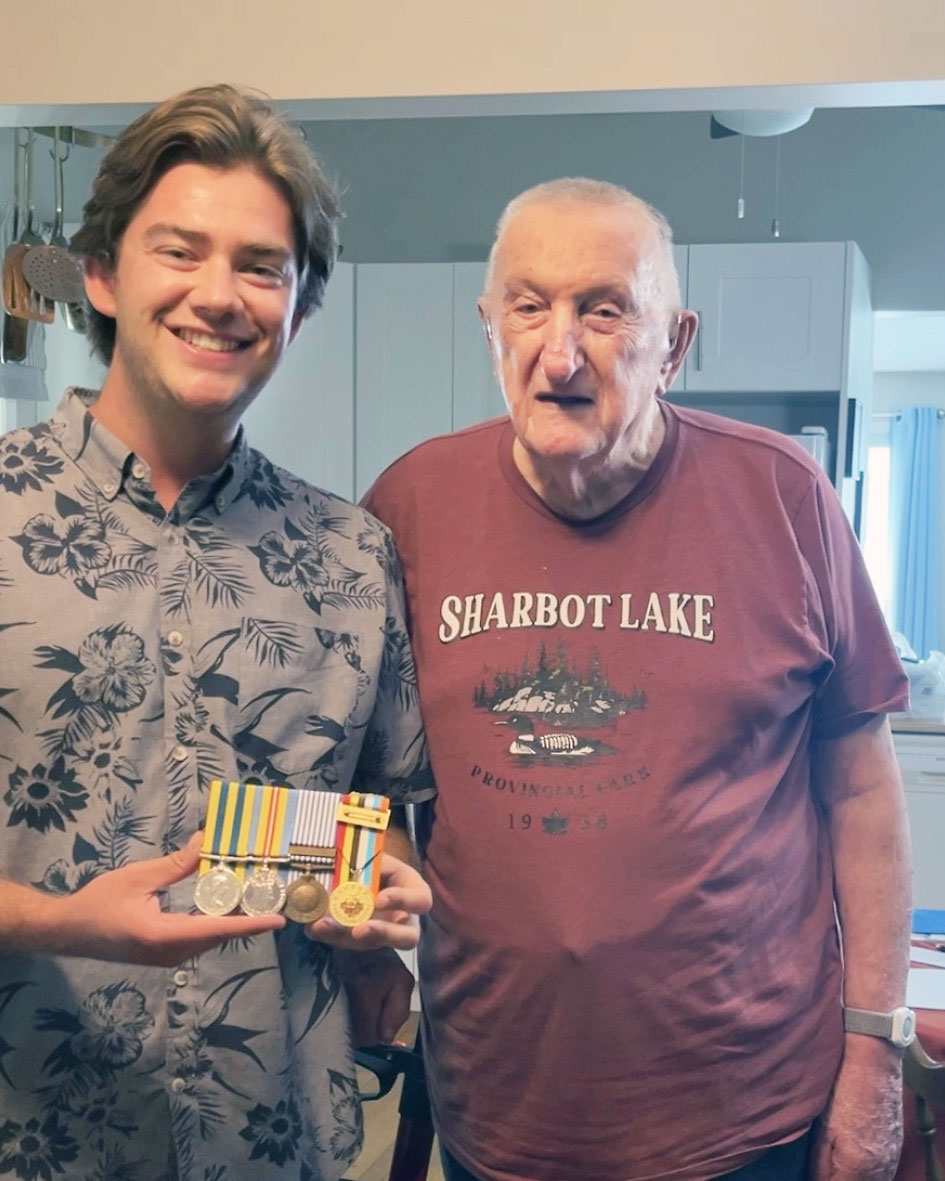
Lloyd Arnold
Frederick Lloyd Arnold, known as Lloyd, was born June 22, 1931, at the Royal Victoria Hospital in Montreal, Quebec, Canada. In 1950, following North Korea's invasion of South Korea, 19-year-old Lloyd answered Canada's call for volunteers. Believing it was his duty to serve. Military service already ran deeply through Lloyd's family. His father, Clifford Arnold, had served during the First World War and had been sent to Vladivostok, Russia, where Allied troops were involved during the Russian Civil War. Lloyd also grew up knowing the sacrifices of relatives who served during the Second World War. His cousin Robert “Bob” Parham, an air gunner, was killed after his aircraft failed to return from a bombing operation, while Bob's younger brother Roy Parham served in the Canadian Army, fought in the Battle of the Scheldt, was wounded, and survived the war.
Lloyd enlisted and initially trained as an infantryman with the Royal Canadian Regiment. After training at Petawawa, Ontario, and Fort Lewis, Washington, Lloyd crossed the Pacific aboard the General H. J. Jaffe. He was stationed at Hiro, Japan, near Kure and Hiroshima, where he completed mountain and Vickers machine-gun training before unexpectedly being transferred into transport duties. Lloyd subsequently entered Korea through Pusan and served as an Army truck driver supporting Commonwealth forces near the Korean front. Driving GMC military trucks, he transported ammunition directly to artillery positions, hauled shells for 25-pounder guns and British Centurion tanks, and moved soldiers into and out of forward positions. Some nighttime ammunition convoys involved dozens of trucks moving toward the guns while bombardments were underway.
One of Lloyd's closest calls occurred when he accidentally drove into a marked minefield. Afraid to leave the vehicle, he carefully reversed along his own tire tracks until reaching the road safely. On another occasion, the blast from an artillery gun firing beside his truck temporarily destroyed his hearing.
Lloyd spent approximately 12 months in Korea before returning to Canada and eventually building a successful career in the plastics industry. For more than seven decades, he never discussed his Korean War experiences. During my interview, Lloyd revealed that he had never even told his father about his service in detail, telling Zach, “You're the first person I've ever talked to about the Korean War.”
Lloyd has lived in the Sharbot Lake/Crow Lake area over nearly 30 years.
James Kierstead
James "Jim" Lorimer Keirstead was born on December 18, 1932, in Montreal, Quebec, during the Great Depression. Raised in a large family of eight children, Jim developed a lifelong love of swimming and art while growing up in Ontario. During the Second World War, his uncle served as a Lancaster bomber navigator over Europe, inspiring Jim's interest in military service. Spending most of his childhood in Sharbot Lake, when he was young, his family's home and business burned down in 1949, Jim enlisted in the Canadian Army, completing his training at Camp Borden before deploying to Korea at the age of nineteen.
Assigned as an ambulance driver with the 25 Field Dressing Station, Jim spent the Korean War transporting wounded soldiers from the front lines to casualty clearing stations and field hospitals. One of the most dangerous moments of his service came in June 1952 when he drove under complete blackout conditions into No Man's Land to rescue casualties after a Canadian patrol was mistakenly shelled. Throughout the war, he faced artillery bombardments, dangerous road conditions, monsoon rains, choking dust, and constant uncertainty while ensuring wounded soldiers reached lifesaving medical care. He later became the personal driver for Canadian field surgeons, witnessing firsthand the dedication of military medical teams serving close to the front.
Returning home, Jim joined the Ontario Provincial Police, where he believed helping people was the true purpose of policing. After leaving law enforcement, he fulfilled his childhood dream of becoming a professional artist, eventually producing thousands of paintings and becoming one of Canada's most respected landscape painters. His Korean War experiences inspired several military paintings, including works now preserved by the Canadian War Museum.