Trail to Somewhere
The only time I have ever visited the first section of the K&P Trail in Frontenac County, which runs from Orser Road to Harrowsmith, was at an event marking the completion of the first section of the trail.
It was somewhere around 2012.
In advance of the ribbon cutting with municipal officials, there was a run/walk/cycle and horseback procession from Orser Road to Harrowsmith, about a 7km stretch. A group of us met at Orser Road, and those on foot, including me, went first. The cyclist and one or two on horseback left a bit later, so we would all arrive at the end together.
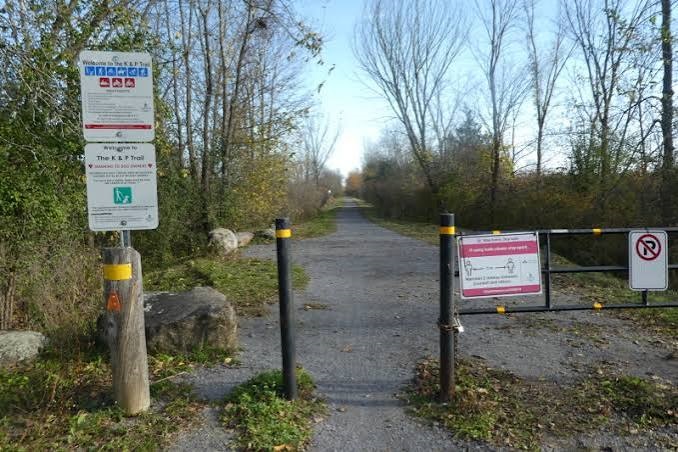
The trail runs along farmland for much of that route, and through some wooded areas. It was my first experience on the luxurious crushed stone and uniform width that is the hallmark of the K&P Trail.
By the time we made it to the photo op, everyone who had made the trip was in a good mood. It was an easy passage on the .5% grade for all of us, the weather was moderate if a bit humid, and it was fun to be part of a group all enjoying a bit of exercise. Those who drove directly to the photo op stayed away from the rest of us because they were wearing “ribbon cutting clothes” and did not want to get sweat stains on their good clothes.
Then Mayor of South Frontenac, the late Gary Davison, cycled the route with his grandson. I think someone put a dress shirt on him for the photo op at the end, but he was still wearing shorts and his legs were strategically hidden by the other politicians and officials in the photo. Davison was never particularly comfortable at photo-ops, but this time he was at ease.
It was a great way to mark the completion of the first piece of the K&P, and some of us talked about an event marking the final completion of the trail.
That day is upon us, sort of. The trail through Frontenac County is just under 90km long, and with the part in Kingston that extends to Lake Ontario it is a 115 km trail.
The Frontenac County section, which took 17 years to complete, cost about $4million to build. Most of that money came either from the Frontenac County portion of a federal infrastructure granting program that Frontenac County now passes on to the local township, to help cover the cost of road and bridge construction. Other sources included provincial grants and a number of trail development granting programs. Local taxation was responsible mainly for smaller allocations, seed money for grant applications for the most part, and some in kind work by volunteers and public works departments.
The largest expense that was borne by Frontenac County ratepayers is not included in the $4million. Two successive Managers of Economic Development, Anne Marie Young and Richard Allen, spent hundreds of hours each, working on the project, at times overseeing land acquisition and expropriation processes because once the trail entered into Central and North Frontenac much of it was in private hands. They also secured funding, managed construction contracts, and they both learned a lot more about the impact of beaver dams in rural settings, than their peers working for other municipalities.
What would normally be done by recreation departments in more populated jurisdictions, was done by the Frontenac County Economic Development Department instead.
The project could have been done much more quickly, for a smaller total expenditure, but members of Frontenac County Council, from 2008 when it was first proposed, to the present day, have always provided support for the project so long as it did not have a noticeable impact on the county budget.
So, it has been a slow, grinding effort.
But now that the trail is about complete and it is an asset for the entire community.
It puts Frontenac County into the Trans Canada Trail family, and coupled with the Cat and Rideau Trails, it provides connections to what is finally becoming a viable trail network linking Frontenac County with the Ottawa Valley and with Lake Ontario.
At the same time, it has become a treasured recreational trail for local runners, cyclists, dog walkers and ATV riders (North of Verona) alike.
Will all this have an economic development impact?
It might, but a lot of other things need to happen. Trail tourism in Eastern Ontario would need to become something more than what it is, and Frontenac County alone can't make that happen.
But focussing on economic development as a stand alone concept misses the real value of the K&P Trail to the residents of Frontenac County.
In 1968, the former township of Oso, with a population of only 500 people, spent $25,000 buying up some cottages in order to create the Sharbot Lake beach. It was controversial at the time.
That was a lot of money back then, the equivalent of spending $250,000 today, of $500 per person, $2,000 for a family of four.
It would be like Frontenac County spending $15 million in local taxation dollars in a single project, which would never happen.
Given that the K&P trail cost $4 million, without using local tax dollars, it has been a really cheap build.
The Sharbot Lake beach has not made us the new Muskoka, or Prince Edward County, but its hard to imagine Sharbot Lake without its beach and all of the resulting benefits for the community at large.
The K&P Trail, thanks in part to the changes that came with COVID, is that kind of essential asset.
In spite of all the issues and grievances surrounding its build out, and the final hurdle at the top end that is still in front of the courts, the K&P Trail is already a winner for Frontenac County residents