Artistic Pairings at the Wild Art Walk
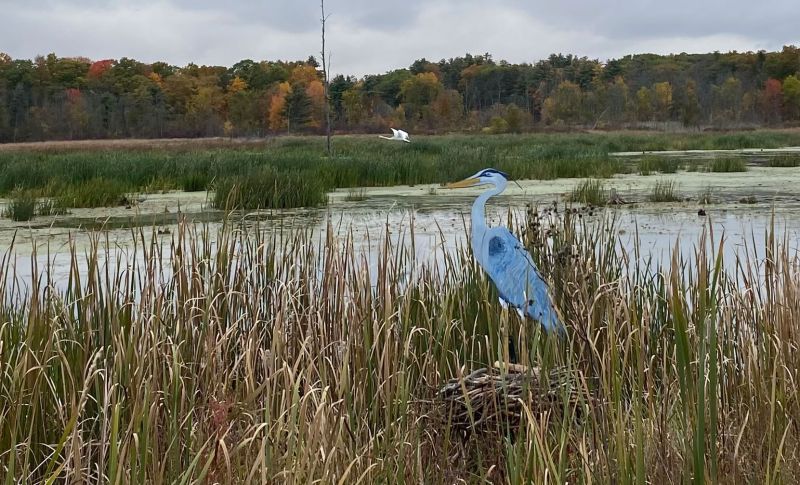
The Wild Art Walk is a month-long art exhibit that happens yearly in October on Milburn Creek Nature Trail in Battersea. The walk takes you through woods, meadow, along a meandering creek and right now it also takes you on a journey past more than 20 art displays spread out over the length of the trail. There is something for everyone. Small sculpture and large sculpture, paintings and assemblages, metal art, fabric art, community art and conceptual art. There is surprising, beautiful, unique, poignant and other-worldly art.
When I started the art walk in 2023, it was important to me that the show not be juried, or even curated. I wanted anyone to participate and be able to choose where and how they displayed their art (within a framework of guidelines for displaying art in a nature reserve). This means it is a surprise every year to see what emerges on the trail. I get some information about each piece before the show starts, but often very little and very last minute. It is not until the beginning of October, after the art has been installed that I finally take in the whole exhibit. It is so exciting to get out for that first walk around the trail to see what everyone has created and how each piece works in relation to the natural environment and to the other pieces.
One thing I’ve noticed over the years is that despite artists not knowing what each other will be bringing to the trail, there are often pieces that reflect, compliment or seem to be in conversation with each other. It is fascinating to see connections between two or more pieces, either in concept or in design, and like any fine pairing, experiencing them together can add to the appreciation of both. Following are some examples of artistic pairings (or groupings) I see in the month-long installations on the trail this year.
One very obvious theme unfurled right away. Nests. While there are three pieces with the name nest in the title, and two others which have a nest within their piece, certain ones speak more to each other than others. Erika Olson chose to nestle her painting of an empty nest unravelling, entitled Empty Nest, into a tangle of a fallen tree on the west side of the pond. While on the east side of the pond in the birch grove Melissa Hutchison created a sculptural piece, also entitled Empty Nest, by ravelling up branches, and creating shape with twigs and found materials.
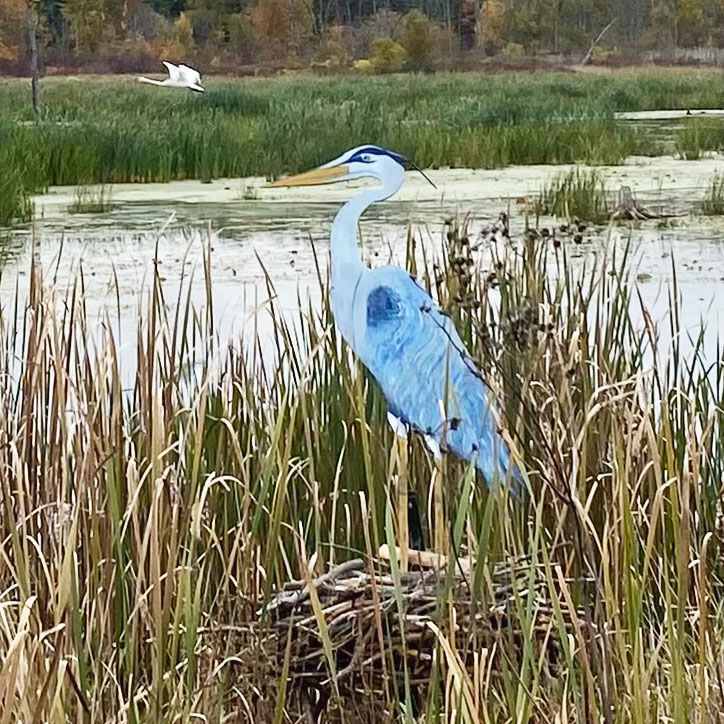
Rich Ludlow’s The Nest (Le Nid), a painting of a heron in a nest, sits above the cattails, becoming one with the geese, swans and herons at home in the pond. Similarly, Sharon Freeman’s Pileated, a scale sized Pileated Woodpecker made of water-proof paper-mache, sits seemingly at home high on the side of a dead tree full of holes.
This trio of pieces explores the theme of home and shelter in other ways. Marcus’s installation and painting Home Sweet Home represents the experience of being unhoused and making a home in a tent in the woods on a small spot of land. This piece reminds the viewer of the injustice of homelessness while also acknowledging that one must find home where one can, and that home, no matter what it looks like, is a precious place that everyone deserves. In Noopiming (Anishinaabemowin: in the bush), Elspeth Lamplugh, a white, English woman, new to living in Canada explores her complicated relationship to her new home. Her experience of wrestling with the discomfort that arises in attempting to see the history of this country and the land through an Indigenous lens and her attempt to learn respectful ways to be in relationship with it is the background to this piece. An Old Barn is a beautiful assemblage of salvaged pieces of an old barn that burnt down on Milburn Creek Nature Reserve Property. The barn stood across the street from the home the artist grew up in. She witnessed it change over many years. She collected metal hinges, nails, charred wood and metal panels from the wreckage of the fire, recognizing it as having been a gathering place for local teenagers, and a final resting place for many animals.
There are a lot of different ways art pieces can reflect each other. Jane Derby’s painting on corrugated metal titled Red Birches is a beautiful rendering of these trees. The shape of the corrugated metal canvas creates texture, shape and shading, making it seem nearly three dimensional. Angela Wiseman’s woven piece Autumn’s Diverse Promises has a similar effect. Textured ribbon, old ties, birch tree branches, and other natural materials were used which bring contour and depth to the abstract landscape.
On either side of the pond you will find a pairing of installations that invite you to go into the trees and beyond them to a place that is unseen. Anne Dumais’s Wind Phone is an interactive piece that welcomes walkers to speak to their loved ones who have passed. Either by entering the “booth” and using the wind phone, or by writing words on a chalkboard, the words washing away when it rains. Sarah Wiseman’s Veil Between The Worlds attempts to immerse walkers in that ethereal space between the material and mystical world using soundscape, poetry and wind.
This next pairing I make is more abstract. Marco Reiter’s Prison or Integration? is a beautiful carved wood sculpture, an abstract figure reaching, perhaps. Yet it is held, or trapped within metal mesh and a broken concrete cylinder. Gordon Darrall’s Final Notice is very different in tone and medium to Prison or Integration? but there is something about the message left for humans from the outer world in Final Notice, that evokes a similar question. Are we or will we be imprisoned by this outer world, or are we integrating into a new one?
My favourite pairing this year was one that did not come to me on my first time around the trail, but after a few walk-throughs I had an aha moment. Hanging from an overhanging tree branch and made of tree roots, Will Freeman’s Ideas is a brilliant sculpture of a brain while inspired. On the very opposite end of the trail, also hanging from an overhanging branch with a similar though smaller shape is R. Bruce Downey’s Bulblebee Wasp Hive. Not only does Wasp Hive mirror Ideas in shape, but in other, not so obvious ways. While the Ideas artist statement muses on interconnectedness and our capacity for brilliance, Wasp Hive is literally made of lightbulbs and represents a bee/wasp hive, one of the most complex structures made by one of the most intelligent insects, who are known for their interconnected social structure.
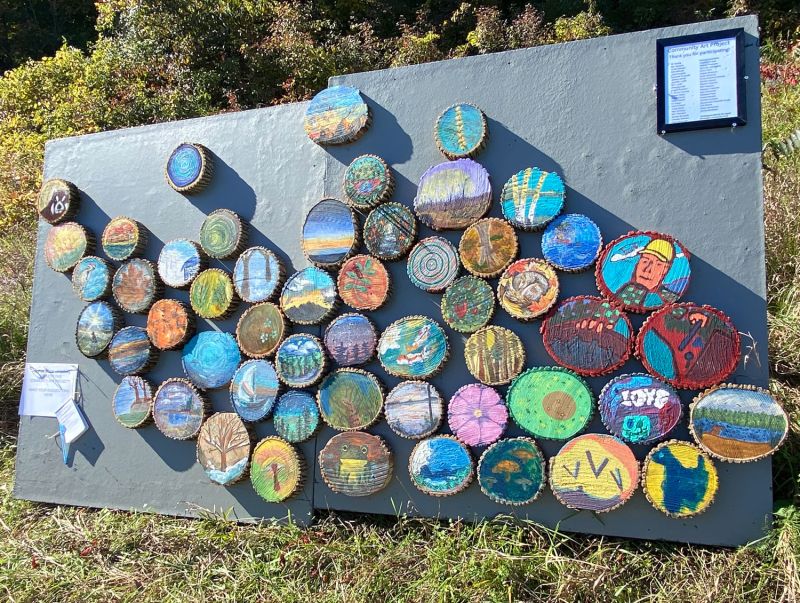
Speaking of social structure, I found I had to step away from the pairings idea and include a grouping of pieces which all appear in groups themselves. Starting with a book collection of poems at The Poetry Bench by eight poets, and a rally of words hanging from trees and embedded in stones in Woodland Whispers Compassion Poetry by Jennifer A. Lovitt. There is a family of painted gourds (and a gramaphone) titled A Gourdgeous Place to Live, by the Freedom Farm Garden Club, a species of flowers made of recycled metal cans titled Popcandensia by Elinor Rush, a brood of painted rocks titled L’il Mazinaabiks by Trisha Tisdale, and a community of round wooden discs titled Everyone’s An Artist Here painted by over forty members of the wider community.
The final piece I will mention is one of a kind, yet it has so much to say about every other piece on the trail, and perhaps the very reason myself and the Wild Art Walk committee make this event happen every year. In his pointed commentary on the artist statement for Absence Number One, a painted typing text bubble, Sean Morris says “The Lorax asked us to speak for the trees. But we don’t… For the trees, for anyone.” Art that nests itself into the trees for a whole month like this exhibit makes sure that the artists and those who walk the trail to see the art, engage with the trees, see them in new ways, listen to, speak for and be inspired by them. The stories shared on the trail through art gives voice to the connections between and the strength of both the human and natural world.
If you walk the walk (any day for free until October 30th), I’d be interested to hear if you agree with my pairings, or if you see connections between pieces that I didn’t. Find a map with art piece locations and information and a guest book to sign in zippered folders at each end of the trail. Email [email protected] for more info.